Throughout the 1950s, Esmond and Nora enjoyed a steady stream of work. Whereas Nora worked primarily on stage and in occasional films, Esmond did both equally, and gradually attracted more television work towards the end of the decade. The medium was by no means new to him, of course - he had been involved in a number of pioneer television broadcasts from Alexander Palace in the late 1930s. They had a lovely home in Bywater Street, Chelsea, and an equally lovely country retreat in Weston Turville - Nora's Ark. Life was good.
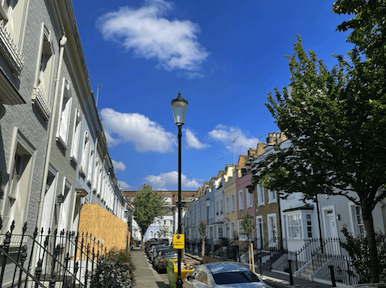
Bywater Street, Chelsea - the Knights lived at number 35 (the grey house on the right, behind the tree) from September 1945 until the mid-1970s. It had, in Nora's words - "Three bedrooms, a pretty bathroom, beautiful big kitchen, nice dining-room with a patio outside the big glass windows and a cloakroom with a loo downstairs." Later on they shared the street with another person of note, albeit fictional. Novelist John Le Carré selected Bywater Street as the home for his spymaster, George Smiley, who lived at number 9 (almost opposite 35), apparently because the street is a cul-de-sac which makes it difficult to keep under surveillance.
(Photograph Copyright John Hughes 2026)
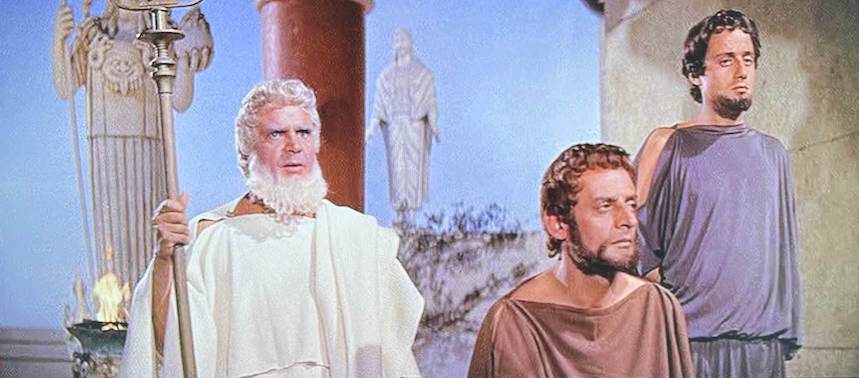
In 1955 Nora was invited to play the part of Hecuba in a big-budget film, Helen of Troy. It was a pleasurable task as it meant going back to Rome for filming at the Cinnecitta Studios and working with a strong cast that included Stanley Baker, Niall MacGinnis, Cedric Hardwick, Harry Andrews, plus a young Brigitte Bardot as Andraste. Esmond was involved too. He went to Italy alone ahead of Nora to coach Jack Sernase, who played Hecuba's son, Paris, in English as he had a strong French accent. However, during filming, the elderly Italian actor playing the High Priest kept forgetting his lines. He had a lot of announcements to make and every time he started he would dry up and filming ground to a halt. It was decided he would have to be replaced. Esmond knew the script and Nora encouraged him to approach the director, Robert Wise, and offer his services. Esmond didn't like to push himself - so Nora pushed instead! Esmond soon found himself in the make-up department being fitted with a beard and wig, and a long white robe. The next morning, he was on set - and word perfect.
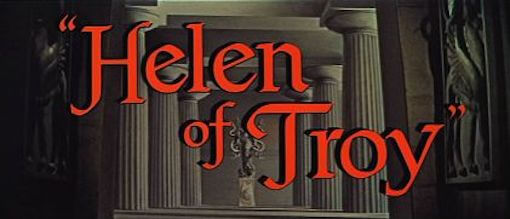
(Left) The opening title from Helen of Troy (1956) in which both Nora and Esmond appeared.
(Right) In his role as the High Priest, Esmond often had to stand for long periods of time without any dialogue.
One afternoon, after a good lunch with wine, he had difficulty staying awake and the cast subsequently
nicknamed him the 'High' High Priest.
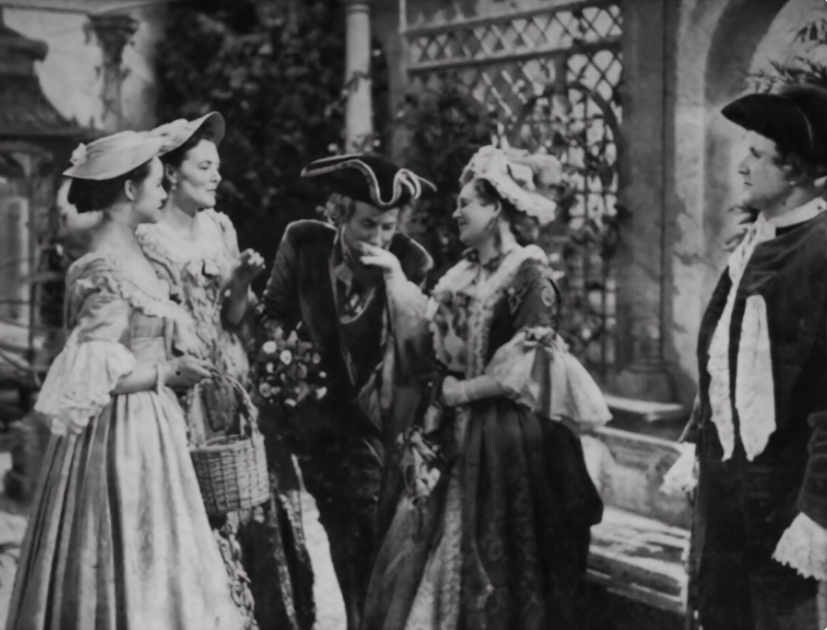
The Clandestine Marriage, a BBC production in their Television World Theatre series, broadcast on 16 March 1958. Left to right: Doreen Aris, Helen Lindsay, Geoffrey Bayldon, Hermione Baddeley, and Esmond. Rosalind Knight was also in the cast.
On the small screen Esmond was involved in several prestigious projects in the late 1950s. In 1957 he played Wackford Squeers (Senior) in a BBC adaptation of Charles Dickens' Nicholas Nickleby, with Rosalind playing Fanny Squeers. Also in the cast were his old friend Douglas Wilmer and a young(ish) Barry Foster. As chance would have it, Dickens described Squeers as "one-eyed", and so Esmond, happy to oblige and not for the last time, felt no compunction about removing his glass eye for the sake of authenticity. The following year, father and daughter were again cast together in the 18th-century comedy The Clandestine Marriage, part of the BBC's Television World Theatre series. Esmond went on to appear in two more of the BBC's highly acclaimed Friday night Dickens series of the late fifties and early sixties - as Silas Wegg in Our Mutual Friend (1959) and splendidly as the unsavoury Ned Dennis (Dennis the Hangman) in Barnaby Rudge (1960).

As Silas Wegg in the BBC's 1959 adaptation
of Charles Dickens' Our Mutual Friend.
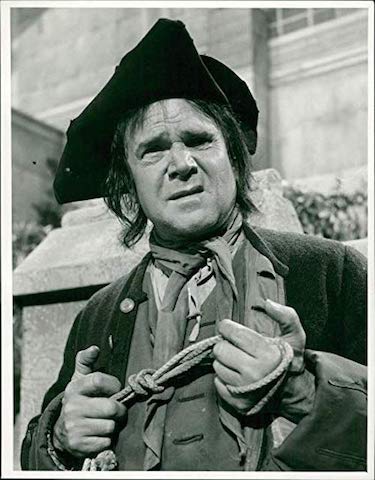
As Dennis the Hangman in the BBC's 1960 adaptation
of Charles Dickens' Barnaby Rudge.
On the subject of glass eyes, Esmond had many made over the years of different shapes and colours. Eventually he found a man in Kent - an ex-airman - who made him such a perfect one that people often thought that it was his good eye. Whenever he went away he always took a spare in case he lost the good one. Glass eyes that were no longer used also came in handy, as Nora recounted: "I remember once I thought the maid in our hotel was eating our chocolates, so I put a glass eye in one of the empty paper wrappers - and it seemed to stop them disappearing. I expect it gas her a fright … the seeing eye!"
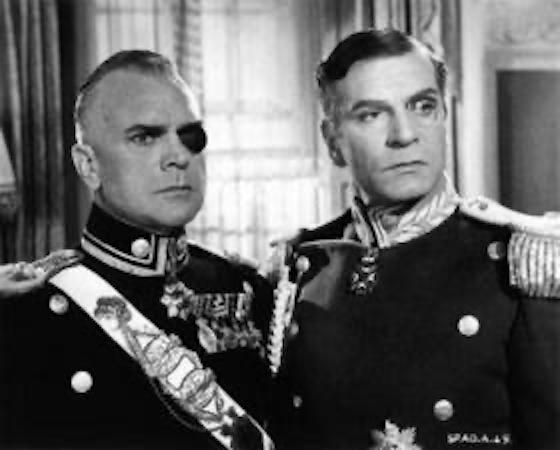
Esmond with Laurence Olivier in a scene from the 1957 film The Prince and the Showgirl
in which Olivier is couple with Marilyn Monroe as the eponymous characters. Esmond plays
Colonel Hoffman, a member of the Carpathian delegation and loyal attendant to the Prince on his
visit to London. Here they appear to be waiting patiently for Marilyn Monroe to turn up on set.
(Picture under licence courtesy of Alamy Images)

Another classic BBC presentation in which Esmond appeared at this time was the 1958 Sunday-Night Theatre adaptation of The Lower Depths, Maxim Gorky's 1902 stage play of the same name. It's a grim piece of social realism about a group of Russian destitutes all living in the cellar of a squalid flophouse near the Volga River. It had a strong cast with Leo McKern, Wilfred Lawson and Miriam Karlin in the lead roles - also Alfred Lynch, George Benson and Diane Aubrey. Esmond played Bubnov, a humble capmaker, down on his luck, who seeks solace in drink, as do all the characters to one degree or another. Grim indeed but very well done.
Esmond and Nora next worked together on an enjoyable project that saw them travelling to Switzerland to film their scenes for a Walt Disney production, Third Man On The Mountain (1959), working with Ken Annakin who had directed Nora as 'The Colonel's Lady' in Quartet a decade earlier.

On the set of This is Your Life - from left to right: Eamonn Andrews, Rosalind Knight, Esmond and (seated) Nora Swinburne.
(Picture courtesy of Rosalind Knight)
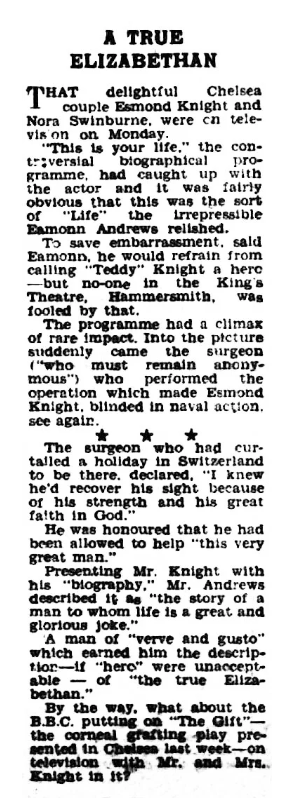
The man with "the red book" in those days was Eamonn Andrews, and for thirty minutes he talked through Esmond's life and introduced family, friends and colleagues including Balliol Holloway (the actor who worked with Esmond in his early Old Vic days), Nurse Thorday (who had looked after him in hospital in Iceland), Dr Vincent Nesfield (who had restored his sight), Enid Hayworth (the matron at Nesfield's nursing home), Michael Shepley (schoolfriend and fellow actor who worked with him in the film Henry V), Michael Buxton (a shipmate from HMS Prince of Wales who survived the sinking), Rosalind and Nora. Uncle Chas could not be there - he was in Kenya and not well enough to travel, and in fact died later the same year. But he had recorded a message for Esmond in advance which was played during the programme. Earlier that day, Chas had sent a telegram to Esmond's home that read: "All good wishes, I shall be speaking to you later, old boy, love Chas." Fortunately it didn't arrive until after Esmond and Nora had left home for the evening (Esmond thought he was going to the theatre), otherwise it would have given the game away.
The programme was transmitted live from the King's Theatre, Hammersmith, the very theatre where Esmond had run a repertory company with Wilson Barrett eighteen years earlier, in the months leading up to the outbreak of war.

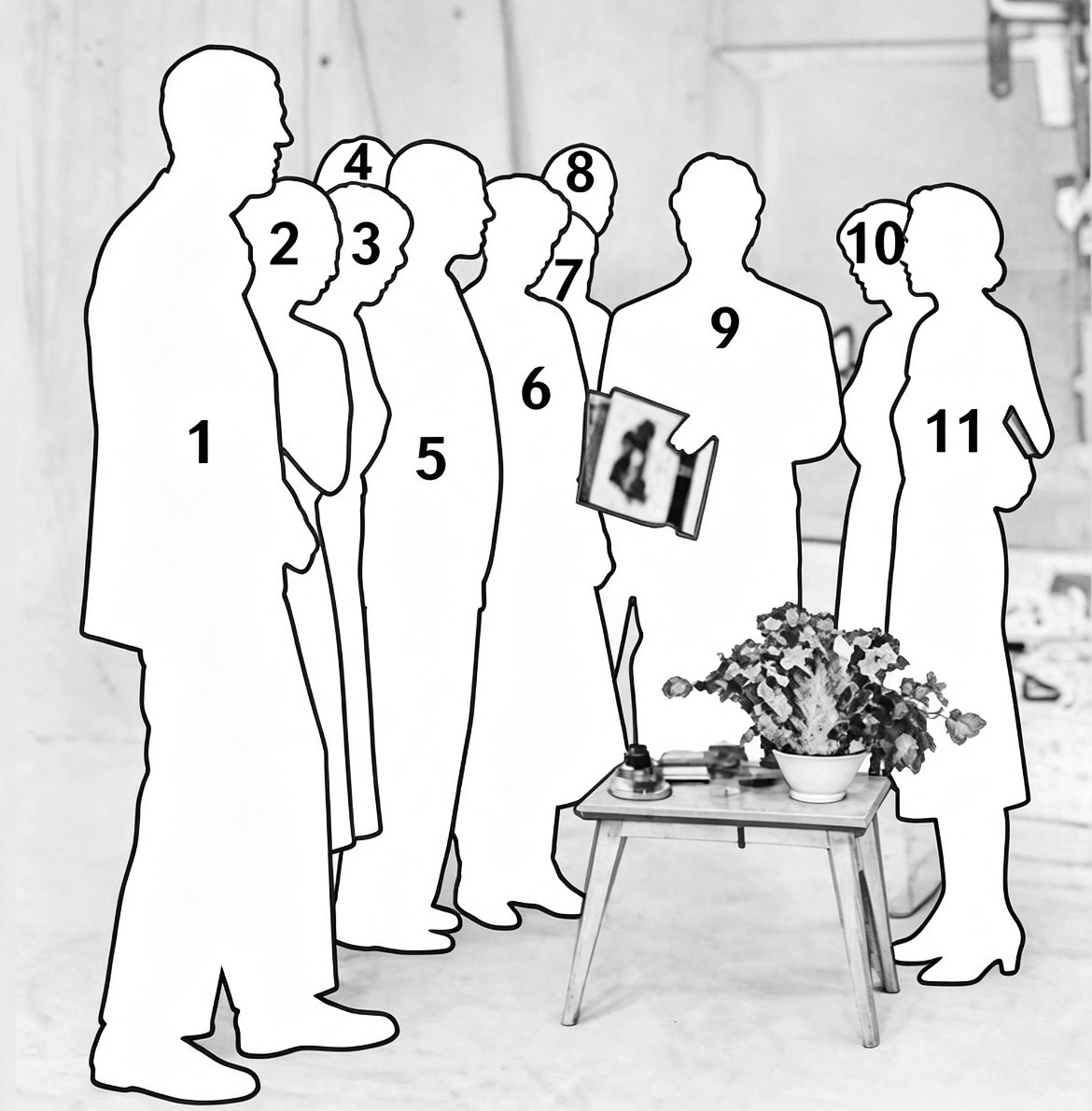
Esmond with guests on his This Is Your Life programme:
1. Michael Buxton 2. Rosalind Knight 3. Enid Hayworth 4. Balliol Holloway
5. Wilson Barrett 6. Nurse 'Bluebird' Thorday 7. Dr Vincent Nesfield 8. Michael Shepley
9. Esmond Knight 10. Nora Swinburne 11. Sally Duncan
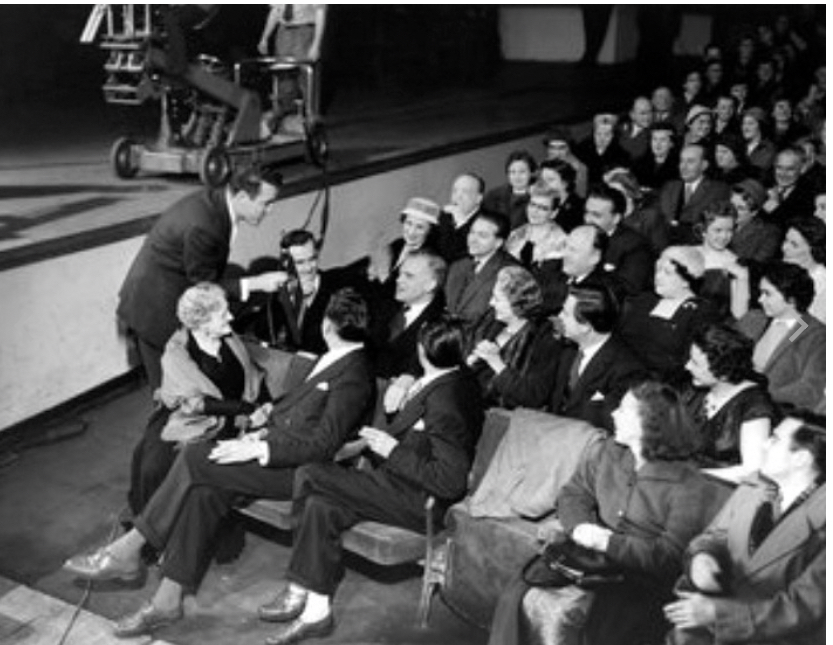
Eamonn Andrews surprising Esmond in the audience, blissfully unaware that he was the star of the show that evening.
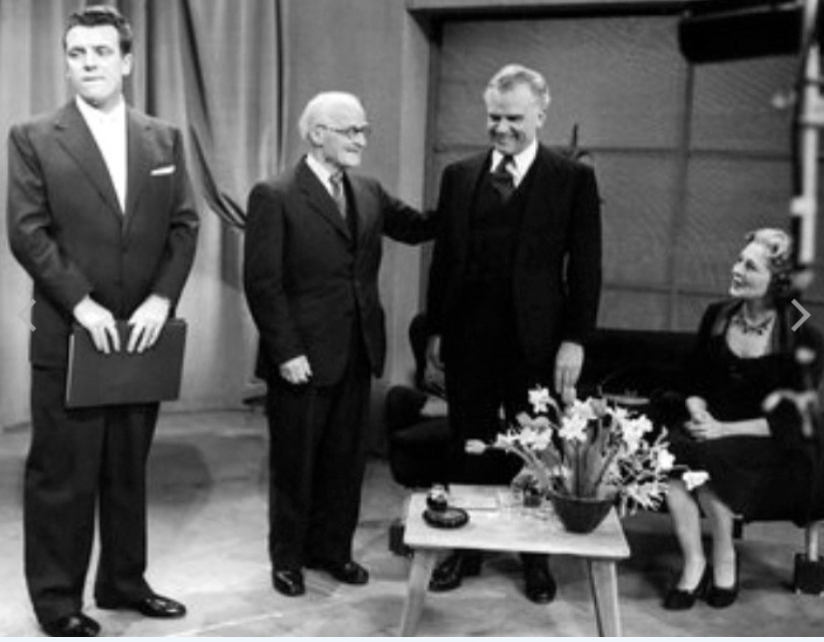
Reunited with Dr Vincent Nesfield, the man who, thirteen years earlier, had restored sight in Esmond's right eye.
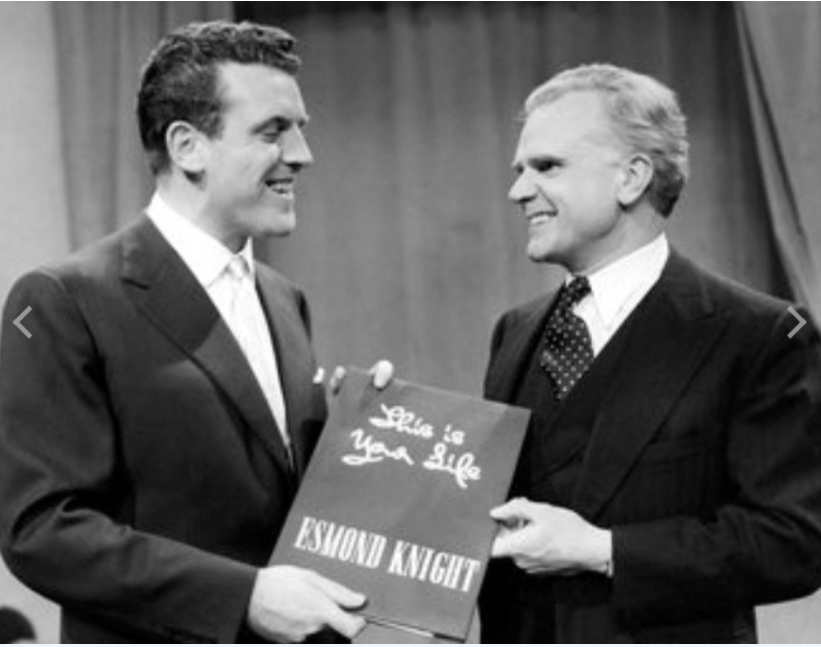
"Esmond Pennington Knight - this is your life."
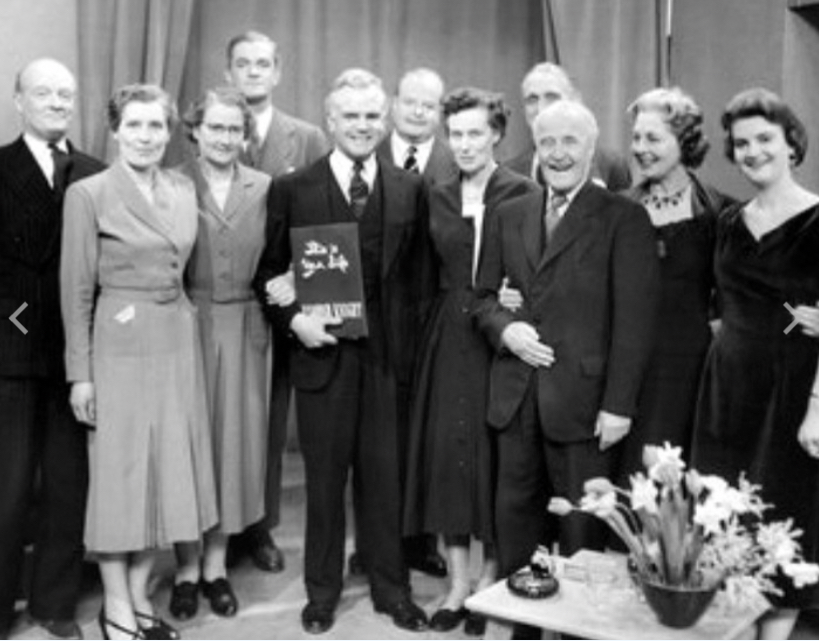
Esmond with all his guests that evening.

A recording of the Flashback programme in which Esmond and Muellenheim-Rechberg eventually meet can be seen on the website Big Red Book - A Celebration of This Is Your Life. The clip also explains in more detail how Uncle Chas nearly scuppered the entire show! Another has a charming interview with Rosalind Knight, recalling memories of the programme.
In the absence of the hoped for "mystery guest", the final guest presented to Esmond that evening was Dr Nesfield, who was in fact himself shrouded in mystery. Despite the time that had elapsed since his treatment gave Esmond some sight back - and even longer since he was removed from the GMC medical register - it was still not permitted to identify him publicly as a doctor. Thus, he was introduced by Eamon Andrews not by name, but anonymously, simply as "the doctor", as reflected in the shooting script for the programme:
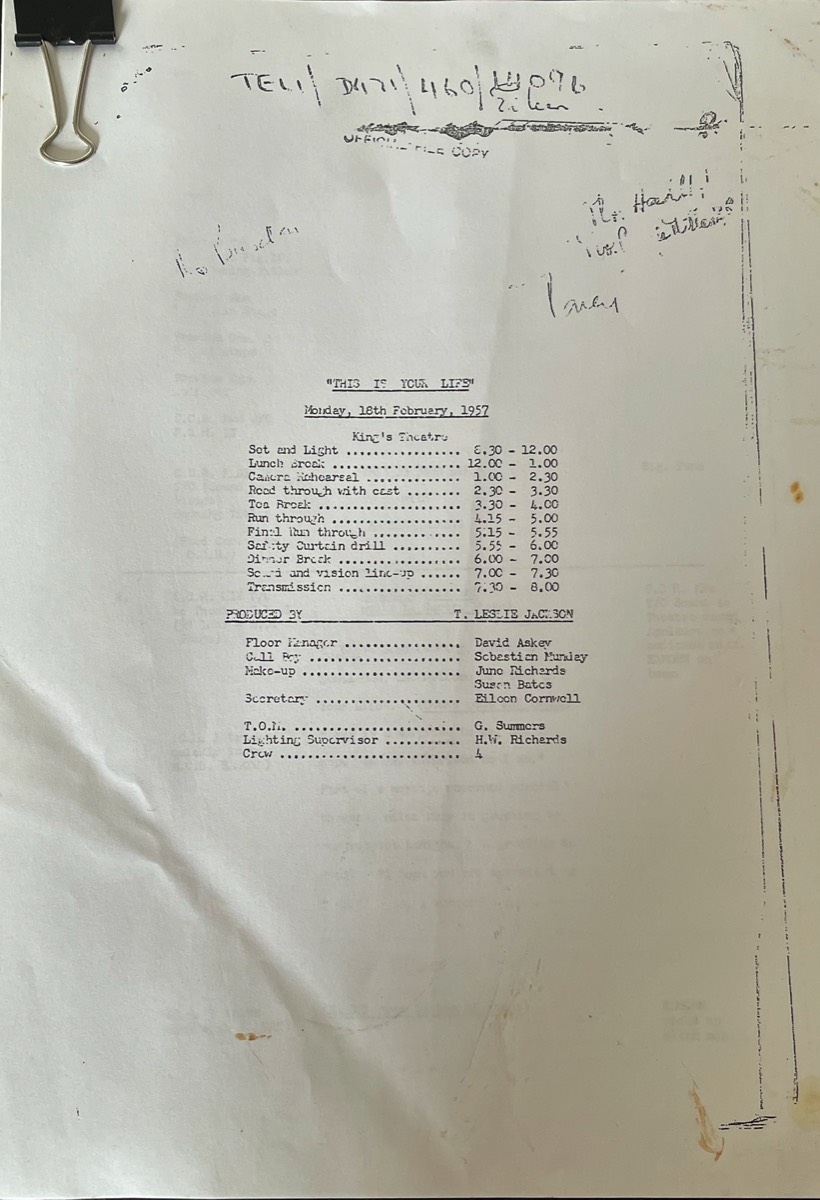
(Above left): The front sheet of the shooting script for Esmond Knight's This Is Your Life programme - broadcast on Monday 18th February 1957 from the King's Theatre, Hammersmith, the theatre Esmond himself had managed during 1939 in partnership with Wilson Barrett until war intervened and nearly all theatrical life in London ground to a halt for the next five years.

(Above right): The last page in which the final 'mystery' guest, Dr Vincent Nesfield, is introduced anonymously, and Esmond is handed the big red book!
(Right): A review of This Is Your Life published in the West London Press four days after it was broadcast - 22nd February 1957.

Sink The Bismarck! (1960) - the film directed by Lewis Gilbert that told the
story of the Battle of Denmark Strait and the subsequent chase and sinking
of the Bismarck, in which Esmond re-enacted scenes from his own life.
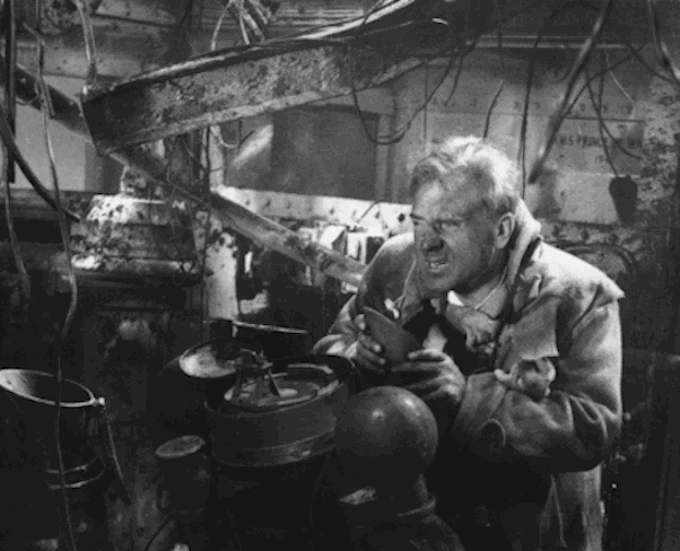
For Esmond it was a production with an extraordinary personal connection, for he was invited to play none other than his own commanding officer, Captain John Leach, and he found himself on a set at Pinewood Studios re-enacting moments from his own life. As Leach, he broadcast a message to the crew warning them they would soon be moving to action stations, a message he himself had heard as a crew member. As Leach he watched HMS Hood blow up and sink before his eyes, as Esmond had done in real life. Then, as Leach, he staggers on the wreck of the bridge immediately after the impact of the shell from Bismarck which had blinded Esmond, surrounded by the dead and wounded (including Esmond himself), shouting orders to the engine room to alter course and make smoke.
(Photo courtesy of Alamy Images)
(Photo courtesy of the British Film Institute)
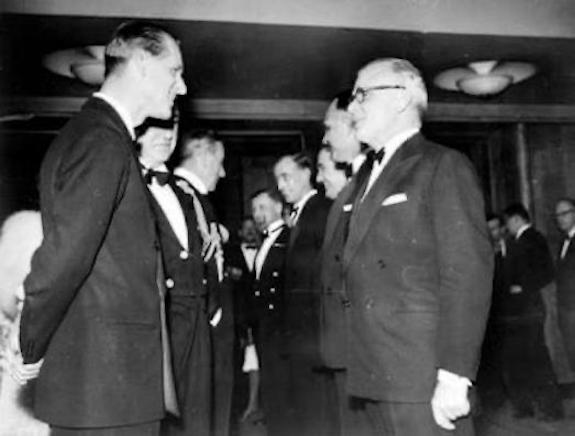
(Left) Esmond being introduced to Prince Philip, Duke of Edinburgh at the premiere of Sink the Bismarck! (15 February 1960).
(Right) Esmond portraying Captain John Leach, his own commanding officer on board HMS Prince of Wales. Here, the shell from Bismarck that blinded Esmond in real life has just struck and Leach is ordering to pull away from the battle and make smoke.
For Esmond the 1950s came to an end with an appearance on BBC Scotland in a play called Next to No Wife. Written by Charles Campbell Gairdner and C.B. Pulman, the play won first prize in the James Bridie Memorial competition run by the Scottish Community Drama Association (SCDA) before it appeared on television. It's a comedy set in the ancestral home of the Brodie family - Drumtern Castle. Esmond plays the laird, Archibald Brodie, who is dedicating his life to getting his two daughters married and off his hands. (Shades of Hobson's Choice.) Esmond was very much at home in this larger than life characterisation. Next to No Wife was originally broadcast on 17 November 1959.

A grainy image of Esmond in Next to No Wife, a play broadcast by BBC Scotland on 17 November 1959
in which he plays Archibald Brodie, laird of Drumtern Castle. Next to him is Lisa Daniely and on the right, Robert Robinson.
Also in the cast was Joseph Tomelty as the Irish Canon Fergus Brodie.