

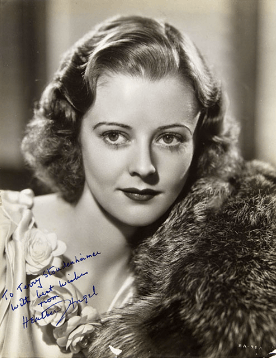
Esmond was not alone when he arrived for his audition at the Old Vic in August 1925. He had to wait his turn. Other successful candidates that day included two actresses who went on to enjoy long careers: (right) Heather Angel, who moved to Hollywood in the 1930s and later appeared in two of Alfred Hitchcock's films (Suspicion and Lifeboat); (left) Margaret Rutherford, whose work I'm certain needs no further introduction!
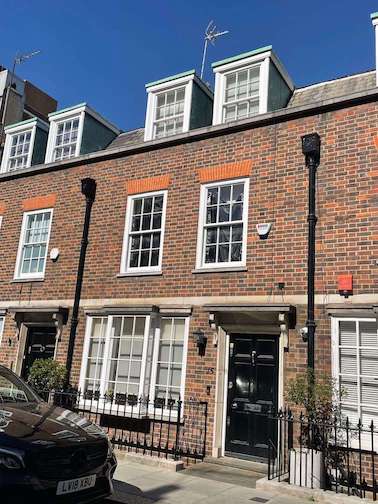
Meanwhile, Esmond had already experienced the thrill of appearing on a stage before even leaving school. His resourceful mother had discovered the Pax Robertson Salon, a small repertory group consisting mainly of amateurs, based at Bedford Hall, a theatre converted from a disused chapel in Chelsea. It was run by Madge Pax Robertson and her husband, Cyril Francis Joseph Stanislaw (also known under various other names including Ivain March and Ivan Stanislaw). On February 22nd 1925, Esmond and his mother went along to hear a performance of Danuncio's play La Giaconda where they met Madge, who invited him to become an acting member of the theatre. As a result, just a few weeks later, on March 15th, Esmond made his first ever stage appearance as Arlecchino in a light comedy by Goldini's Curiosity. Miss Robertson was impressed enough by his performance to offer him a more substantial part in another production soon afterwards of Ibsen's The Wild Duck. Pax Robertson played the female lead, Hedvig, her husband was her father, and Esmond was given the role of Old Ekdal, her grandfather - no mean feat at eighteen to play an ageing drunkard! He was even mentioned in a review of the performance in The Stage magazine five days later: "Her [Hedvig's] father Hialmar Ekdal, was played with flamboyant humour by Mr Ivain March , and the drunken old grandfather was represented effectively by a promising newcomer, Mr. Esmond Knight." It was valuable practical experience, and no mean feat at eighteen to play an ageing drunkard!
[NB - In his autobiography, Seeking the Bubble, Esmond states that his first role at the Pax Robertson Salon was in The Wild Duck and his second in Curiosity. However, the list of plays and dates for that season (below left) clearly indicate that it was the other way round.]
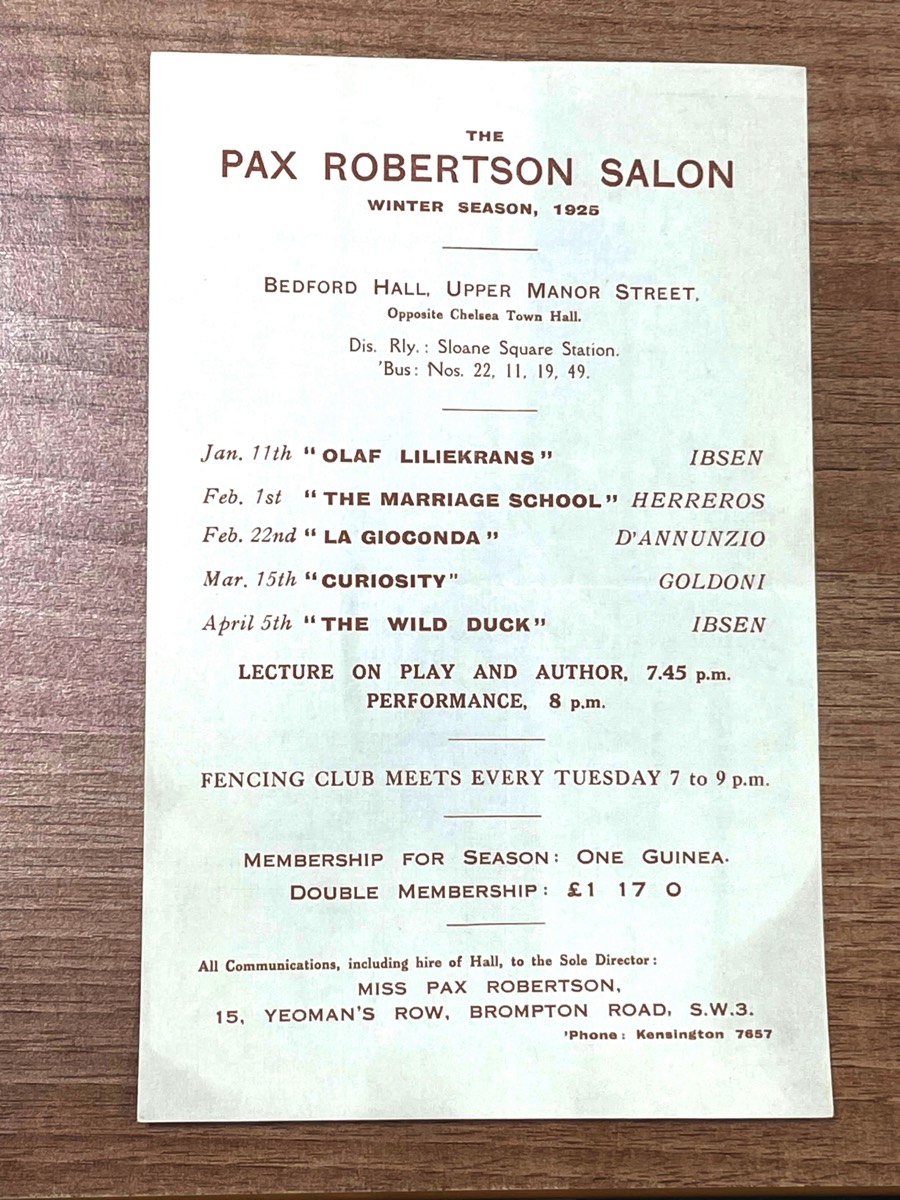
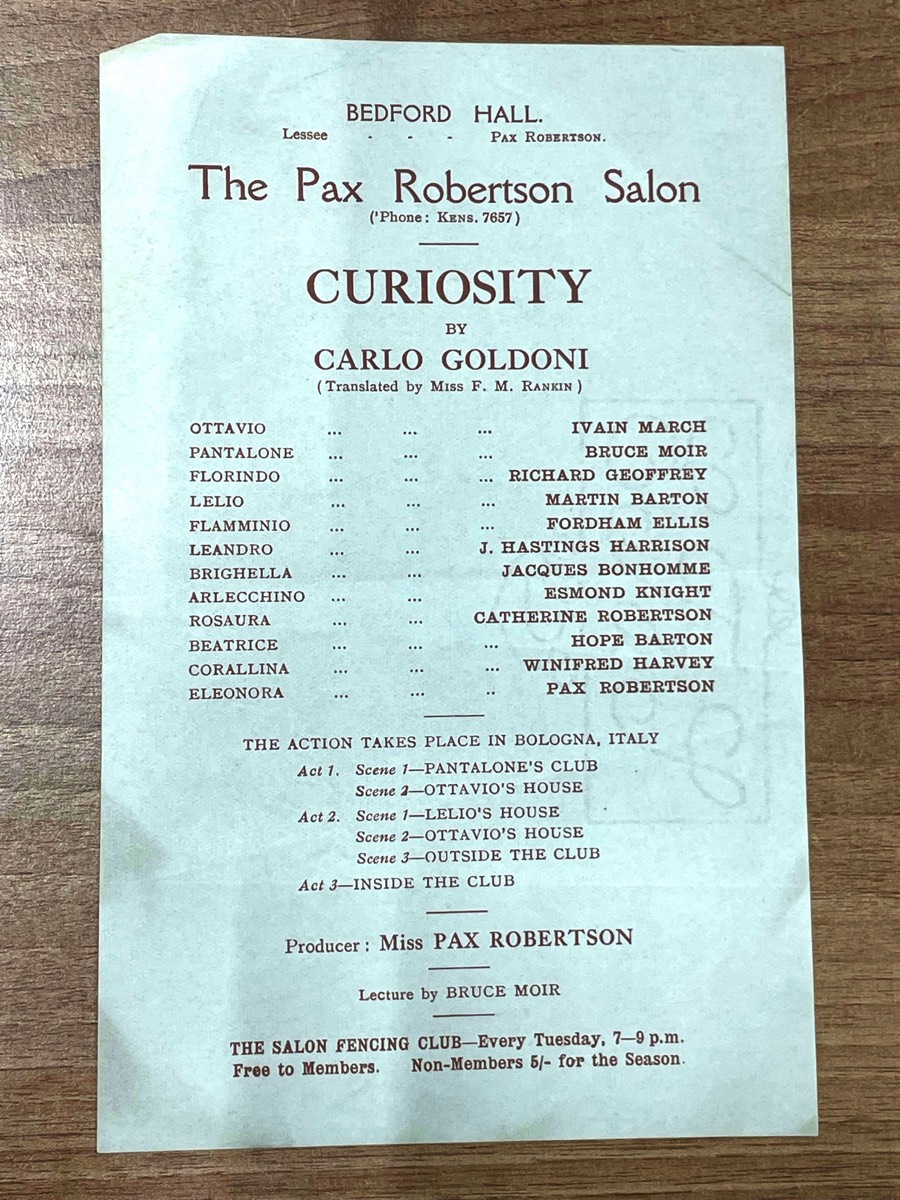

Above Left: The 1925 Winter Season of plays presented at the Pax Robertson Salon.
Middle: The cast list for Curiosity, Esmond's first appearance on a public stage, March 15th 1925.
Right: The cast list for The Wild Duck a few weeks later on April 5th, and repeated on April 26th.
(Photos courtesy of the Royal Borough of Kensington and Chelsea Archives)
Of those early days at the Old Vic, he later wrote: "I realised as soon as I had got over the nervousness of the first day's rehearsals that this was the life for me. I had never been so happy. I stayed in the theatre every day as long as I could without appearing too foolish. I arrived at the stage door of the Old Vic long before rehearsals began and went home after everyone else had left." His first role was as Balthasar in The Merchant of Venice, a modest part in a cast which included Edith Evans no less. This was followed by the Marquess of Dorset in Richard III and parts in Measure for Measure, Julius Caesar, As You Like It, Romeo and Juliet and Much Ado About Nothing. He also appeared as an extra in operas such as Aida, Carmen and Don Giovanni.

A programme from the Old Vic's production of The Merchant of Venice on September 12th 1925, Esmond's professional stage debut, just two months after his last day at Westminster School. Throughout the 1925/26 season he played numerous parts, all of them modest, but all valuable experience for a novice actor learning the ropes.

Esmond's first notice, for his part in Richard III, did not hint at his future success. Theatre critic James Agate, having praised Edith Evans and Balliol Holloway for their performances, added: "But Mr Esmond Knight, as the Marquess of Dorset, reminded us more of the football pitch than a royal palace." This was presumably a reference to his over-muscular legs. However, his athleticism did not fail to impress others, if not the critics. Ninette de Valois, who gave lessons in ballet to students at the time, saw his potential and tried to entice him, unsuccessfully, into training as a ballet dancer. As an actor Esmond must have done something right for he was invited by Lilian Baylis to return for a second season at a salary of £1 a week, this time appearing in more than a dozen plays including Macbeth (playing at least four parts), King John, Twelfth Night, Henry V, The Winter's Tale, Comedy of Errors, A Midsummer Night's Dream, plus more ballet and extra parts in operas such as Carmen and Lohengrin. He also played the juvenile lead in Dr Syn, an adaptation of the novels by Russell Thorndike (Sybil's brother).

A damaged but rare photograph from the 1926/27 Old Vic season, taken on New Year's Eve 1926, and the play is Twelfth Night.
Esmond, aged just 20, plays Fabian and on either side of him (left to right) are; John Garside (Sir Andrew Aguecheek), Bertram Marsh-Dunn (Sir Toby Belch) and Grace Allardyce (Maria).
(Photo reproduced under licence courtesy of Shutterstock Images)
When the busy 1926/27 season at the Old Vic eventually came to an end, Esmond began the sometimes arduous task of developing a career as a jobbing actor - doing the rounds of agents' offices and taking any and every opportunity that came his way to gain experience. At length he managed to find a small part in a play called The Return at the Everyman Theatre in Hampstead (with a very young Peggy Ashcroft in the cast) and then two opportunities came his way and he had to make a decision between a long tour to the West Indies and South America with Shakespearian actress Florence Glossop Harris, or the offer to join the Birmingham Repertory Theatre Company. Tempting though the former was, he chose the latter, because the Birmingham company then had the reputation of being the best permanent company in the country. The play was called Yellow Sands.
(Right) Esmond's personal copy of the script for Shakespeare's history play The Life of Henry V, which he owned during his time at the Old Vic. The company performed the play during his second season there, in October 1926, and he played the part of the Duke of Bedford (King Henry's brother). Baliol Holloway played King Henry and Heather Angel was also in the cast. The script is seen here open at the beginning of Act IV, set in the early hours ahead of the battle of Agincourt, and King Henry is about to wander in disguise amongst his troops - A Little touch of Harry in the night. The notations in pencil were made by Esmond himself. This fascinating piece of memorabilia was auctioned online not so long ago and sold for an undisclosed sum.

The Birmingham "Rep" had been founded in 1913 by director and entrepreneur Barry Jackson who was also responsible for building the theatre which was their home. Fortunately for Esmond, with a foot in the door of this prestigious company and lots to learn, the engagement lasted a year, mostly on tour performing in cathedral towns such as Exeter, Gloucester and Lincoln. He played opposite an attractive actress called Frances Clare, two years his senior, who very soon became the focus of his romantic attention - and subsequently Mrs Esmond Knight. (Had he taken the West Indies offer they would never have met!) He later wrote:
"I had to make love to her. It was fun sitting on the upturned boat in a scene that we had together, plastered with a bronze make-up and having to say all those things to her which I hadn't quite the courage to say offstage."
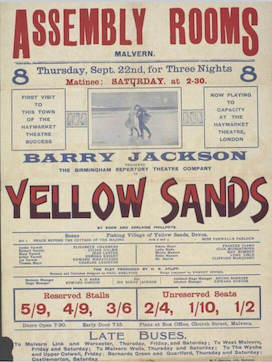
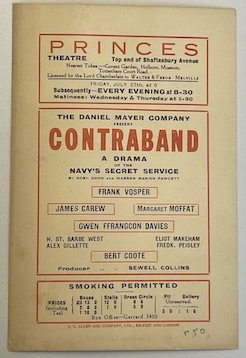
Posters for:
(Left) the Birmingham Repertory Theatre Company's touring production of Yellow Sands in 1927, the play in which Esmond found himself sharing the stage with his future wife, Frances Clare;
(Right) Contraband - Esmond's first West End production at the Prince's Theatre (now the Shaftesbury Theatre) (1928) which also generated his first positive notice from critic James Agate.
(Yellow Sands poster reproduced in consultation with the Library of Birmingham, curators of the Barry Jackson Archive)

During 1928 Esmond and Frances (or 'Fran' as she was more often referred to) became secretly engaged, and in the autumn they again appeared on stage together at the Gate Theatre Studio in London. The play was called Fashion (or Life In New York) by Anna Cora Mowatt, and when the production transferred to the Kingsway Theatre, Esmond stayed on at the Gate to appear in another play, To What Red Hell by Percy Robinson. The leading role in the latter was played by Frederick Peiseley whose highly vigorous performance was complemented by Esmond's calmness, a contrast that did not go unnoticed by the observant, omnipotent theatre critic James Agate: "But the performance which moved me most was that of Mr Knight who never batted an eyelid during the evening."
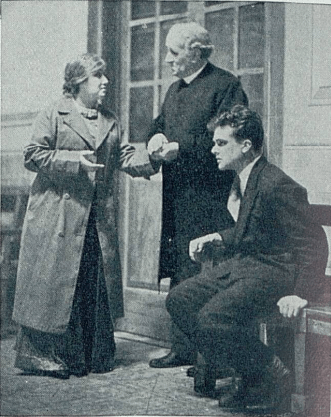

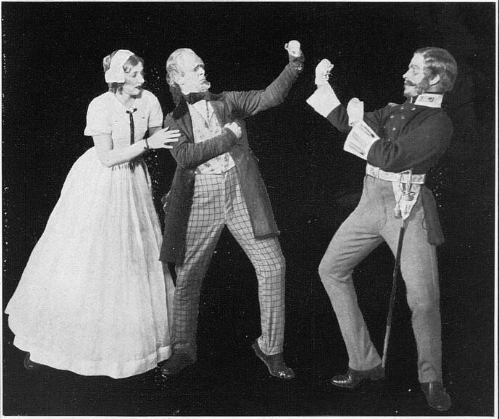
Esmond in some of his early roles as a jobbing actor, 1928-29. (Left) - in To What Red Hell at the Gate Theatre Studio. (Centre) - The Return of the Puritan at the Golders Green Hippodrome. (Right) - engaging in fisticuffs in Fashion, also at the Gate Theatre.
Unfortunately, halfway through the run of To What Red Hell Esmond developed mumps and even more unfortunately passed it on to numerous theatrical colleagues and family members, including his parents, before being confined to bed at home in Putney. It was now December and the illness created something of a dilemma for Esmond as he and Fran had made wedding plans for early in the New Year. The banns had been published but he had yet to tell his parents. So it was on Christmas Eve 1928 that he marched somewhat unceremoniously into their bedroom, where they too were confined with swollen faces, and announced his intentions out of the blue!
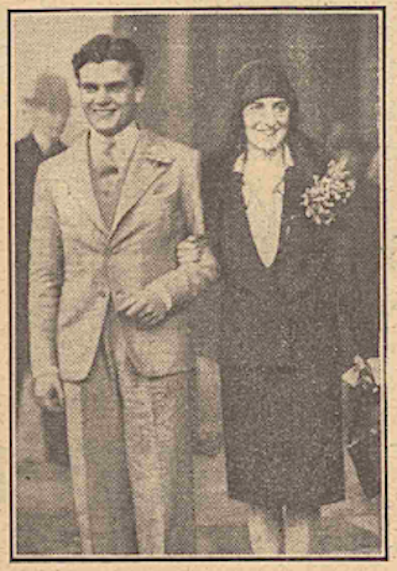
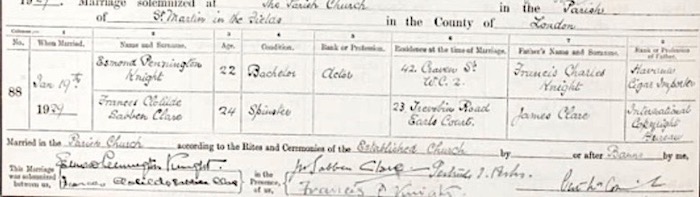
At 9am on Saturday 19th January 1929, Esmond Pennington Knight (age 22) married Frances Clotilde Sabben Clare (age 24) at St. Martins-in-the-Field. Witnesses to the ceremony were Esmond's father and Frances' father, James Clare. That evening it was a case of "the show must go on" - with Fran on stage at the Gate Theatre and Esmond at the Children's Theatre in Covent Garden where he was playing in a series of adaptations of fairy stories and folk songs, including Managee and the Robbers and Today and Tomorrow. Until then, when he wasn't away on tour, Esmond had still been living at his parents' house in Putney, but the newly weds now moved into a flat at No. 11 Clarges Street, off Piccadilly, once the home of Lady Emma Hamilton and which, by Edmond's own admittance "… was far too expensive."
(Right) Esmond and Frances on their wedding day at St. Martins-in-the-Field, 19th January 1929 - as reported the following day in the Sunday Mirror newspaper.
(Below) Their marriage certificate.
Having been reunited on stage in Fashion for a while at the Kingsway, the couple were soon out of work again and so they moved to more modest accommodation at 35 Manchester Street, just off Baker Street. Esmond was forced to leave Fran for a time while he travelled to Paris to join the cast of a play by Simon Gantillon called Maya at the Studio des Theatres des Champs-Elysees. The play was set in a brothel and had been banned in the UK and America; consequently it was drawing huge audiences in France. Esmond was then invited by Albert de Courville, a successful theatrical producer and occasional director, to stay on in Paris to appear in a play about the Great War called The Man I Killed.
At home in England, Fran had gained a part in a play called Nine Till Six in which she appeared with Jill Esmond who during the run married a promising young actor by the name of Laurence Olivier. When Esmond returned in the summer of 1929 he still found it difficult to find work. Depressed and rather disillusioned with the theatre, he travelled down to Sevenoaks to stay with his Uncle Chas, Captain Charles Knight, a well-known naturalist with whom he shared a passion for birds and wildlife. From there he went on to stay with a friend, Vernon Sewell, a technician in the sound department at Nettlefold film studios in Walton-On-Thames, previously the studios of pioneer film maker Cecil Hepworth and where Esmond would soon be making films himself with Michael Powell. Sewell's hobby was boats and they spent some time together on his cabin cruiser at Bosham in Chichester Harbour. While they were there, they witnessed the Supermarine S6 high-speed seaplane fly over as it won the 1929 Schneider Trophy.
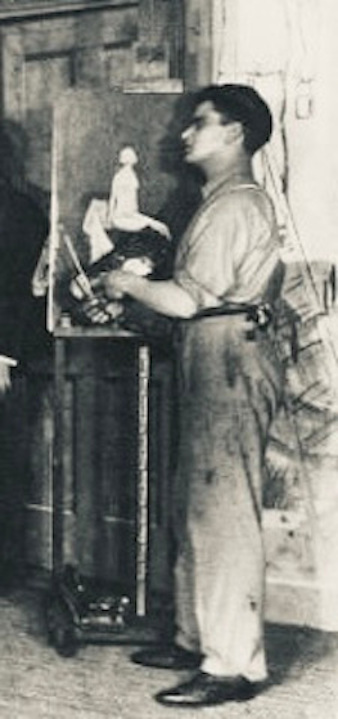
Back in London, Esmond's first job was to help provide sound effects for a radio version of The Prisoner of Zenda with Denis Freeman, with whom he had worked on Fashion. Then towards the end of the year his luck changed and he found work in two plays - The Return of the Puritan at the Golders Green Hippodrome and Art and Mrs Bottle with Joan Barry at the Criterion. Like many actors, Esmond suffered from nerves before going on stage. But for him there had been an additional hurdle to overcome - a stutter from which he had suffered since childhood. He would read through his lines and anxiously look out for problem words beginning with C, P, T, or D in order to prepare to tackle the problem. He discovered that the stutter completely disappeared when he sang: "I used to make up this crazy meandering tune and learn my lines to it." Ironically, in Art and Mrs Bottle he played the part of a nervous young artist who stuttered. Acting an affliction that he normally worked hard to avoid was very difficult, an experience he later described as "absolute purgatory".

Scenes from a comedic three-act play written by Benn W Levy called Art and Mrs Bottle at the Criterion Theatre (1929) in which Esmond plays a nervous young artist, Michael Stockfield, seen here (above) with Joan Barry as Sonia, and (right) at work at his easel. The same year Joan memorably appeared in Alfred Hitchcock's first film with sound, Blackmail. Levy went on to be a Labour Member of Parliament and was married to actress Constance Cummings who, like Esmond, later appeared in the film This England in 1940 (though not in the same scenes!).
Towards the end of 1929, the author of Art and Mrs Bottle, Benn Levy, wrote a new play, The Devil, and seriously considered Esmond for the leading role. Ultimately, however, Levy chose someone else for the part, Denis Neilson Terry, breaking the news to Esmond in his dressing room with the words: "It's no good, Esmond, you just aren't the right shape!" But other opportunities were coming his way. The 1930s began well for him as far as stage commitments were concerned, and he found himself back where he had started his professional acting career five years earlier, as a member of the Old Vic Company in a Shakespeare play, Hamlet, albeit at the Queen's Theatre rather than the Old Vic.
John Gielgud as Hamlet in the Old Vic Company's 1930 production. Gielgud's performance was highly acclaimed, some believing it the finest Hamlet of his era. Esmond played the part of Rosencranz.

The new decade was also to consolidate the tiny foothold he had managed to achieve in the British cinema which had fared badly in the 1920s, struggling to keep up with mighty competition from Hollywood and the huge technical advances surrounding the arrival of "the talkies".
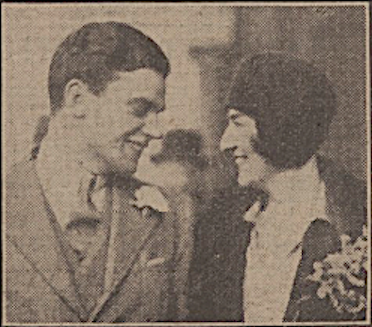
Wedding day - 19th January 1929