Having concentrated on film work for the past two years, Esmond now turned his attention back to the stage. In October 1947, Denham Studios agreed to his request not to renew his contract so that he could take up an offer to join the Royal Shakespeare Company for their 1948-49 season at Stratford-upon-Avon. And what a company! His colleagues were to include Paul Schofield, Claire Bloom, Robert Helpmann, Douglas Wilmer, Godfrey Tearle, Anthony Quayle, John Justin and William Squire. The director for that season was Barry Jackson, in whose Birmingham Repertory Company he had toured in 1927 with Yellow Sands and had met his first wife, Fran.
It was during a performance of The Taming of the Shrew that the inevitable event that some friends and colleagues had predicted came to be - Esmond fell off the stage. One of his entrances required him to stagger onto the stage backwards, but he misjudged his angle, fell backwards and toppled over the edge "… to loud laughter from the audience! Everybody back-stage thought I must have killed myself but I came-to having seen several remarkable constellations in my head, climbed on to the back of the carpenter and pulled myself onto the stage to continue the play."
Nevertheless, his performances were memorable for finer reasons. When writing his obituary for The Guardian almost forty years later, Peter Cole wrote that in the 1948 Stratford season Esmond "made Antonio in Merchant of Venice a more noble character than ever before." (He meant Gratiano - Antonio was played by Noel Willman.)
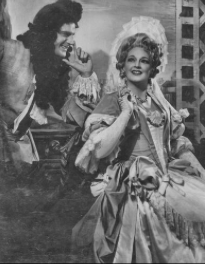
Scenes from productions featuring Esmond Knight, Royal Shakespeare Company, Stratford Upon Avon 1948-49.
All photographs courtesy of Rosalind Knight

The Merchant of Venice
As Gratiano (left) with Noel Willman as Antonio.

The Winter's Tale
As Leontes (left) with Julian Amyes as Camillo

The Taming of the Shrew
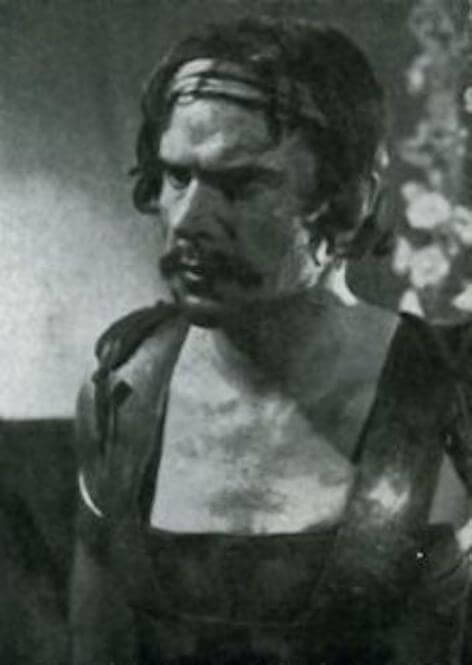
As Christopher Sly (right) with Tom Kneale as Bartholomew
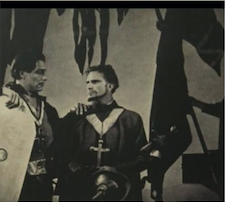
The Life and Death of King John
As Chatillon (right) with John Justin as Louis
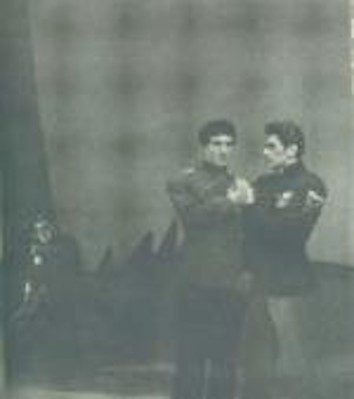
Troilus and Cressida
As Thersites (far left) with Douglas Wilmer (centre) as Achilles and Somebody Else (right) as Thingy
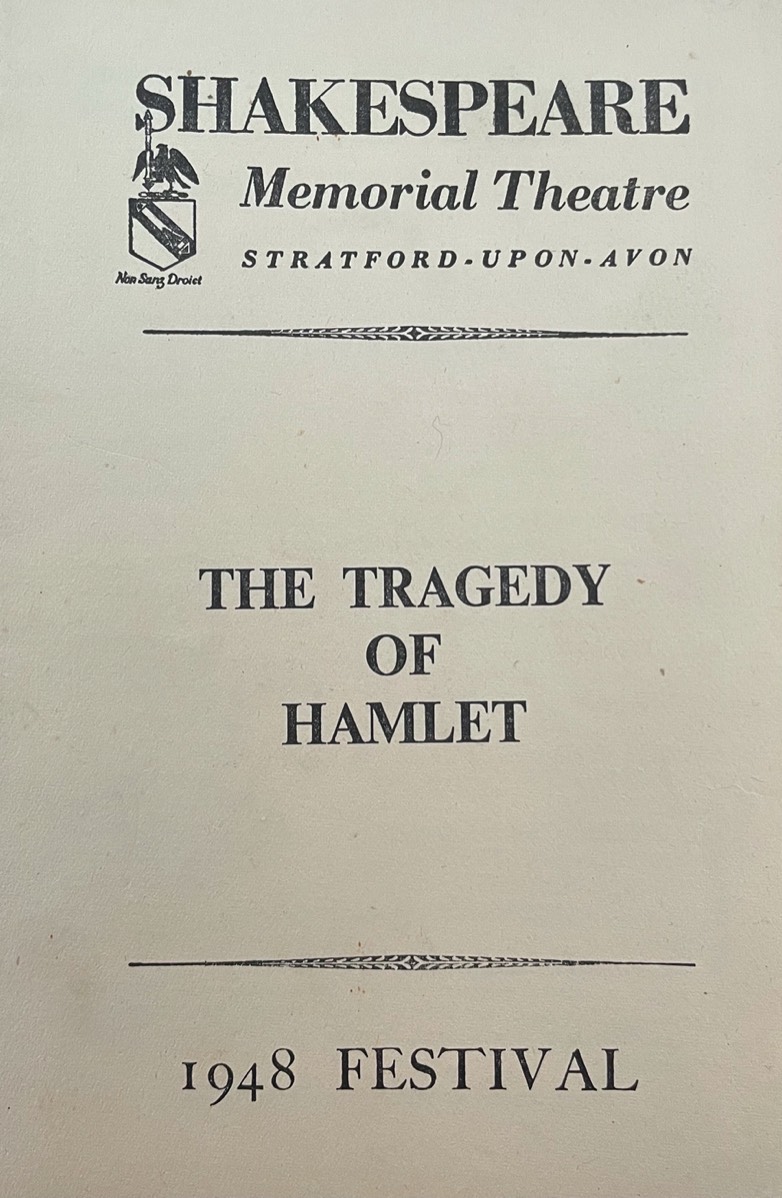
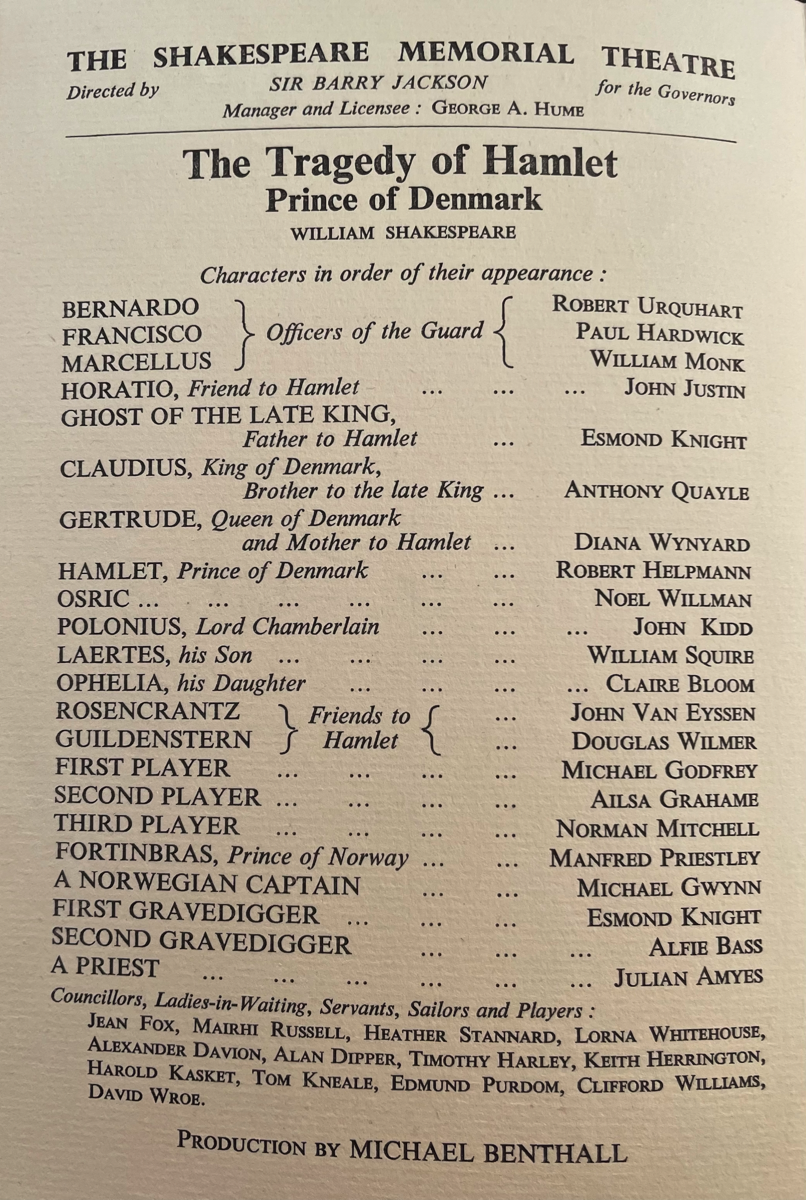
The programme front cover and cast list for the RSC's 1948 production of Hamlet in which Robert Helpmann
played the eponymous role. Esmond had two parts - the Ghost of Hamlet's Father and First Gravedigger -
this in same year he played Bernardo in Laurence Olivier's acclaimed film version. The play was directed
by Sir Barry Jackson in whose repertory company Esmond had appeared in Yellow Sands
back in 1927 and where he met his first wife, Fran.
Something more memorable, and longer lasting, also occurred during that Stratford season. He shared a dressing room with fellow actor, Douglas Wilmer, who was very good at drawing. He urged Esmond to take up painting again. Esmond had always drawn and there were artists on both sides of his family, but he had never seriously tried painting before. This chance remark was the beginning of a long and extremely satisfying pastime that Esmond pursued for the rest of his life. He get into the habit of setting off on his bicycle around Stratford doing water colours initially. "But I used the paints all wrong," he said later. "I banged them on thick like a child, so I could see it." So he changed to oil painting which suited him much better. He painted from memory, recalling images from his thirty-five years of perfect sight and combining them with his more recent experiences. Thus his first work was a self-portrait as Christopher Sly in The Taming of the Shrew, waiting in the wings to make his entry at Stratford. Douglas Wilmer became a great friend to Esmond. They had worked together before, at the King's Theatre in Hammersmith two years before, and at Stratford it was Wilmer who took the time to teach Esmond how to make up by touch rather than sight.
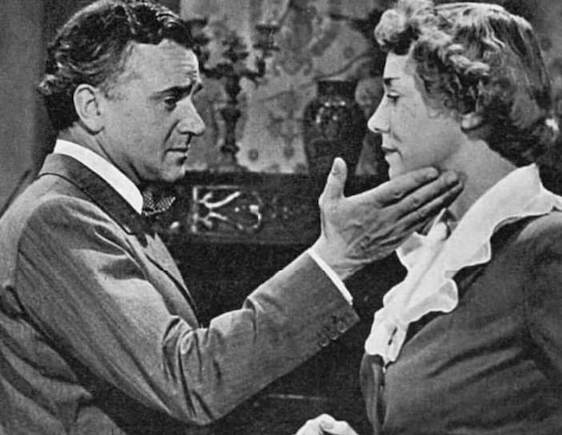
15th April 1950
Darling Teddy
Bless you for your sweet letter, and thank you from my heart for your criticism
which is most useful and about which something is being done forthwith. I wish
you had popped round to see me; I should have so loved to see you again.
Your ever devoted
Larry
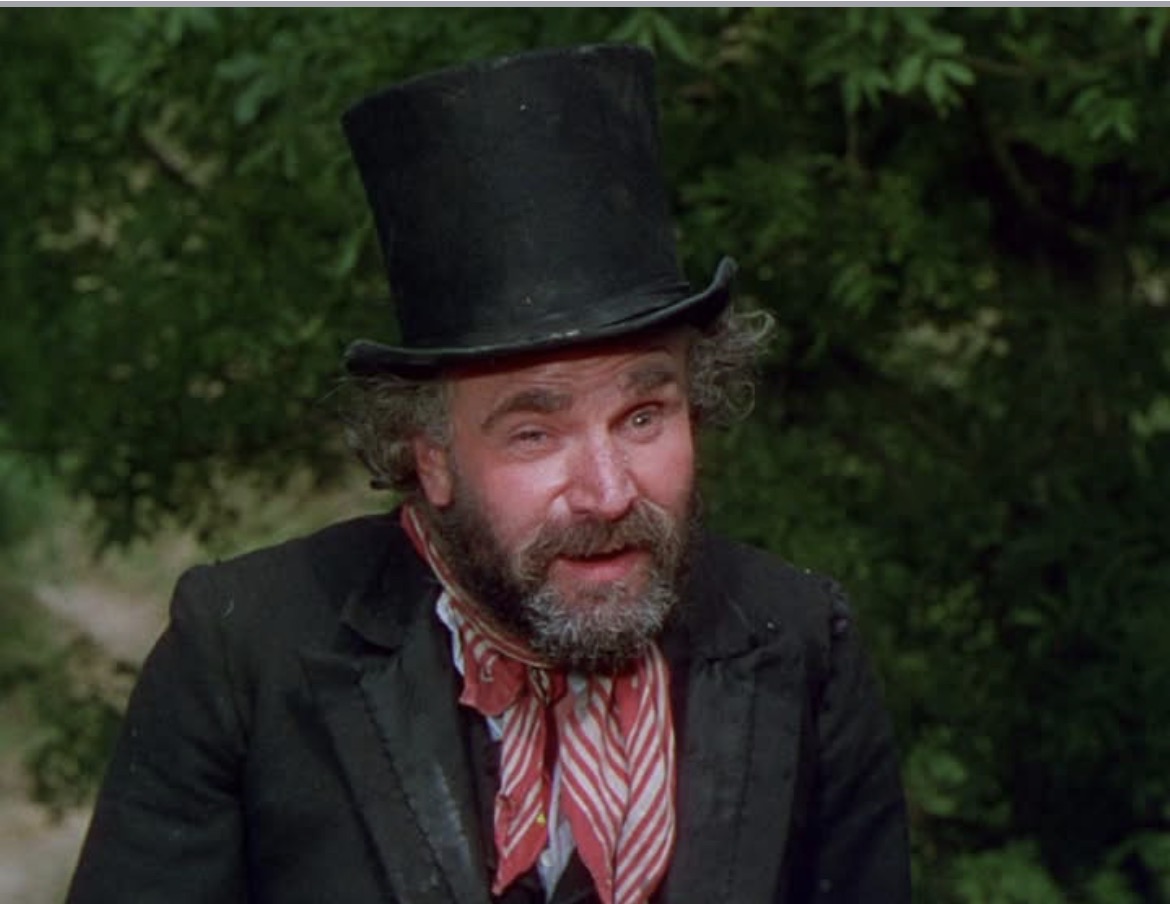
On screen, Michael Powell once again called upon his services in his next film, Gone to Earth, an adaptation of the novel by Mary Webb. The production was a joint venture between Alexander Korda and David O. Selznick, and the heroine, Hazel Woodus, a wild country girl, half-gipsy, was played by Jennifer Jones (Selznick's lover). Esmond was cast as her father, Abel Woodus, an eccentric character who makes a living as a beekeeper, harpist and coffin maker. Mary Webb was a Shropshire lass and Gone to Earth is set in the south Shropshire hills.
So by chance Esmond found himself on location back in and around Church Stretton where he had recuperated at St Dunstan's in 1941 whilst still totally blind. He was able to revisit, and this time see, albeit partially, some of the places where he had walked and cycled (with guidance) nine years earlier during the difficult months when he was coming to terms with his loss of sight, with the fear and anxiety that it might be permanent for all he knew at the time.
Esmond in the Powell & Pressburger film of Mary Webb's Shropshire novel
Gone To Earth (1950). He plays the part of Abel Woodus - coffin maker,
beekeeper, harpist and father of the doomed heroine Hazel.
According to the South Western Star newspaper (10th June 1949), Esmond had recently been chatting to Emeric Pressburger, Michael Powell's film production partner and screen writer, about a garden fete he was due to open along with Nora, at St. Mary-le-Park church, Battersea. There being a similar fete in the the upcoming film, Emeric decided to go along in order to gain some authentic background material, taking with him art director Hein Heckroth. In the article, the vicar, Rev. Brian Dupré, gave welcome assurance that "… there will be no question of parishioners' mannerisms or conversation being copied in the film … so they can feel quite at ease. Nothing special is being arranged, and the fete will follow the customer pattern of such events."
The filming of Gone to Earth turned to something of a family affair. Esmond's cousin Jean (Chas Knight's daughter) trained and supplied animals for the production. They were an important ingredient; Hazel Woodus has a pet fox to which she feels a strong affiliation (in the story she is lusted after and "hunted" by the local squire), and there are scenes which include both fox hunting and horse racing. Although only one fox appears on screen, Jean Knight trained and used two animals during the filming.
Esmond's first wife, Frances Clare, was also in the cast (in a rare film appearance), playing the part of Miss Amelia Clomber. Rosalind also made an appearance as an extra in some scenes filmed at Worcester Races. At this time Rosalind was on the point of leaving school to follow in her father's footsteps and join the Old Vic as a member of its new Theatre School, which had been founded by actor Glen Byam Shaw, an old schoolfriend of Esmond's from Westminster days.
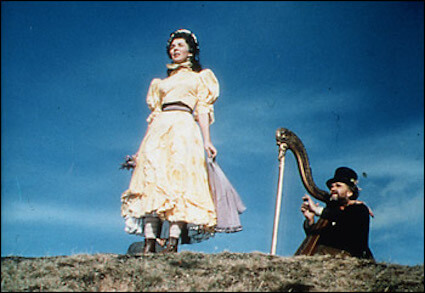
Esmond accompanying Jennifer Jones as Hazel Woodus on the harp as
she sings The Mountain Ash at the village fete in Gone to Earth (1950).
Esmond was on good form as the eccentric Abel Woods, and clearly enjoyed himself in both the part and the process of filming. At one stage whilst on location, he posted a notice in a public position for cast and crew to see which read:
Would anyone who might have found, or STOLEN, a magnifying glass with a loop handle,
please hand over. I am attached to this as it is the only thing which, when studying lines,
appears to make my part seem larger.
Abel Knight
(or during the day)
Coffin matured honey on sale in No.4
The production was not so carefree for the producers. Unhappy with the final film, Selznick sued Alexander Korda (unsuccessfully), claiming Korda had not provided the film that he had commissioned, and re-edited it for release in the USA under a different title - The Wild Heart.
By this time Esmond had moved on and abroad, travelling to India with Nora to work on The River, an adaptation of another Rumer Godden novel about an English family living in Bengal. The director was Jean Renoir, son of the impressionist painter. He had approached Nora initially to play the mother of the family at the core of the story and Nora suggested Esmond as the father, the manager of a jute factory on the banks of the Ganges. Renoir arranged for them to read a scene together and Esmond got the part, which was even adapted to accommodate his limited sight by making his character a wounded war hero.
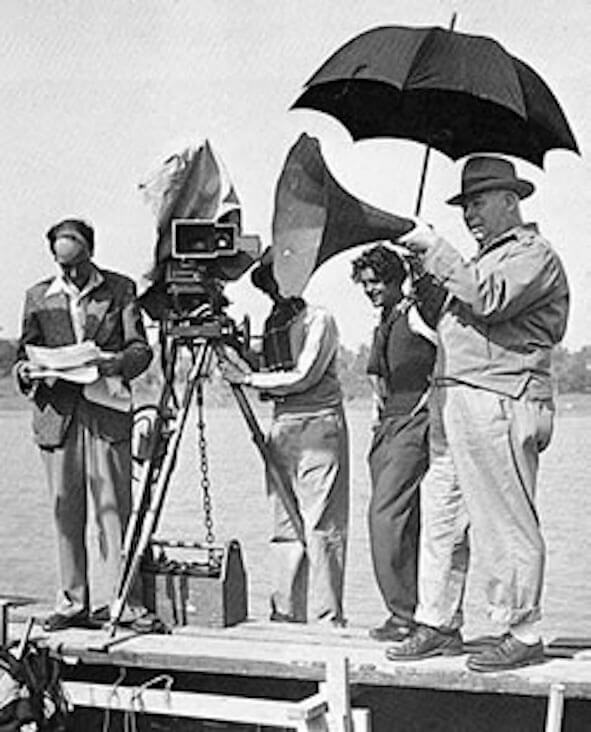
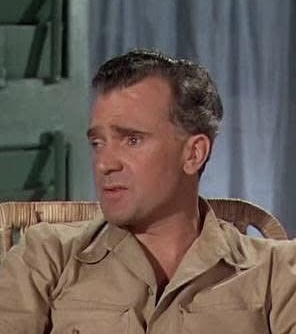
(Left) Jean Renoir and crew directing the final scene
of The River (1951).
(Above) Esmond as The Father - neither he
nor Nora were named in the film.
The River was Renoir's first film in colour and, although rarely seen nowadays, is regarded by some as a masterpiece - certainly a most beautiful and exotic piece of work. Not surprisingly, it won the International Award at the Venice Film Festival that years. For Esmond and Nora it was a delightful experience; they loved India and thoroughly enjoyed their time there, although the poverty that was in evidence wherever they went shocked them, as did tales of violence at this turbulent time in India's history as the country struggled towards independence.
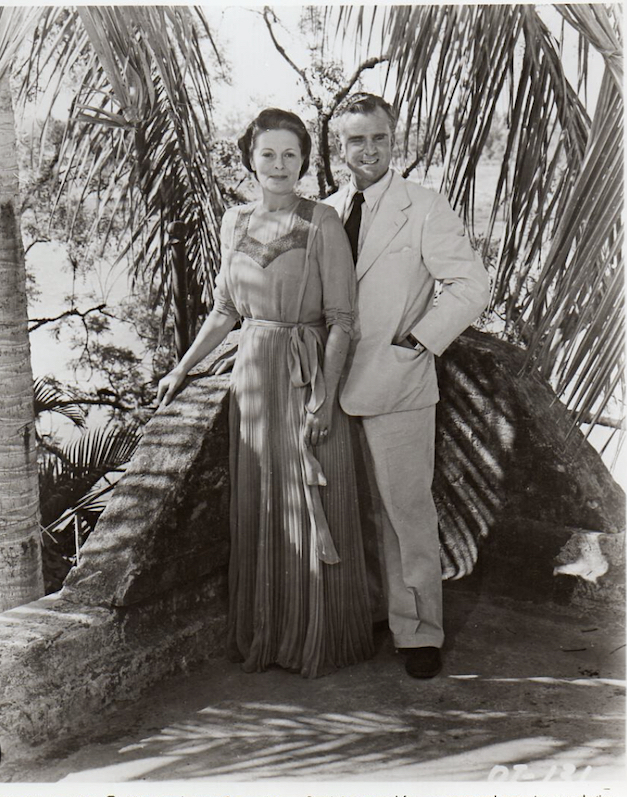
Nora and Esmond loved their time in India during the several months it took to shoot the The River. It was late April when filming was over, and before returning to England Nora treated Esmond to a trip to Darjeeling as an early birthday present. He had always wanted to see the Himalayas. With his limited sight this turned out to be more difficult than expected as the mountains were clouded in mist for most of their stay. It was only on their return flight that they eventually managed to achieve their ambition when a willing pilot made a detour above the cloud base which allowed them a superb view from the plane window.
(Left) In India during the filming of The River -
husband and wife on and off screen.
Back in London, a newspaper revealed that Nora would soon be flying off to Italy to film scenes in a major Hollywood production, Quo Vadis?, with Robert Taylor, Peter Ustinov and Deborah Kerr. (Nora's first line, spoken as a group of Roman soldiers arrive at her villa after a long chariot ride, is the classic: "These gentlemen will wish to wash."). Meanwhile, Esmond, would "probably" be filming The Tales of Hoffman for Powell and Pressburger. But for one reason or another, he did not make it into the cast of the Archers' imaginative realisation of Offenbach's opera.
Nor did another plan mentioned in the same newspaper article come to fruition, the publication of a children's book Esmond had written called Down At Unkers. In April 1950 he was in correspondence with Max Reinhard (husband of Margaret Leighton) of Reinhardt & Evans publishers, discussing the project; a story about animals which would be accompanied by thirteen illustrations by none other than Esmond's Uncle Chas. However, the book never saw the light of day, possibly because the storyline was ultimately felt to be too scary for children.
"I'm not really an interesting fellow at all, but my grandfather was. He invented the deckchair." Thus began an article about Esmond in the West London News on 17 November 1950. The piece covered highlights of his career, his loss of sight, marriage four years ago to Nora, the collection of model soldiers (knights at the battle of Agincourt) and other items of interest around his home in Bywater Street, Chelsea, and … grandfather, Frank Barrett - potter, prolific novelist, and writer of melodramas for actor Sir Henry Irving, both leading lights of London's Savage Club. A versatile gentleman who additionally earned himself an underlying niche by designing the first deckchair - or so Esmond claimed. I've no reason to disbelieve him but on the other hand am struggling to find any evidence to support this delightful story, although Esmond does mention it in his autobiography, Seeking the Bubble. (Frank Barrett was a pseudonym - real name Charles Davis, son of a pork butcher in Bishopsgate and father of Esmond's mother, Bertha.)
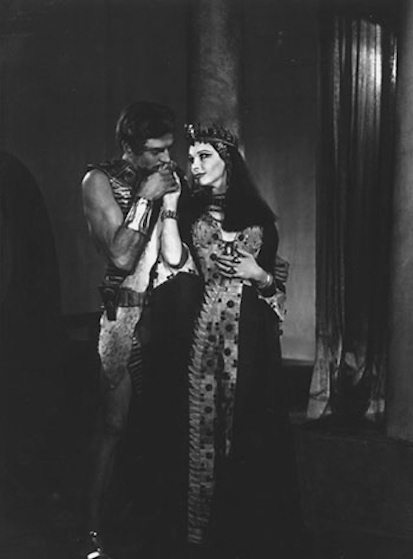
But if unrealised projects were a disappointment at this time, Esmond was in demand elsewhere enough not to dwell over them for long. He was soon invited to participate in a bold theatrical venture by Laurence Olivier intended as a vehicle for himself and his wife, Vivien Leigh - the pairing of Shakespeare's Antony and Cleopatra and George Bernard Shaw's Caesar and Cleopatra, with the Oliviers playing both title roles on alternate nights.
Vivien Leigh and Laurence Olivier as Antony and Cleopatra
in the Shakespeare play - St James's Theatre 1951.
They alternated this with Shaw's Caesar and Cleopatra
with Esmond playing Menas in the one (Shakespeare)
and Belzanor in the other.
They surrounded themselves with a strong cast including Wilfred Hyde-White, Harry Andrews, Robert Helpmann, Peter Cushing and even Desmond Llewelyn as a Roman soldier! The plays opened on 10th May 1951 and, despite some critics who claimed Olivier was lowering his standards to meet his lesser talented wife, the double production was a great success with London theatre audiences.
Esmond played Belzanor in the Shaw play and Menas in the Shakespeare. One evening, the cast had the pleasure of performing to Winston Churchill who, as was his usual custom, booked three seats, one for himself, one for his daughter Mary and another for his hat and coat. Churchill clearly enjoyed the evening. "By Jove," he remark to Olivier about Vivien Leigh after the performance, "she's a corker!"
Esmond as Menas in Olivier's 1951 production
of Antony and Cleopatra.
Meanwhile, back in Italy, Nora was still heavily involved in the production of Quo Vadis. Her role as Pomponia spans the length of the film and shooting lasted many months. When the run of the Olivier double production came to an end, Esmond joined her there, taking Rosalind, whose school had fortuitously closed early due to an epidemic of whooping cough. Nora's son Francis also joined them, on leave from the army. They enjoyed a memorable family holiday together, paid for with Nora's expenses from Quo Vadis?, and even when Rosalind and Francis had returned home, Esmond stayed on in Rome until eventually the offer of work took him back to London.

Esmond and Jennifer Jones - Gone to Earth (1950)