Esmond Knight
1930-1933 Breaking into Films
Having tried all kinds of ways during the late 1920s to find work in the cinema, Esmond's modest break eventually came when he was asked to appear as a radio operator in a 1929 film called The Blue Peter. He prepared for the part by studying morse code and reading up on radio techniques, but when he turned up at the ship in Tilbury docks where filming was taking place, he found that as breaks go it was a very modest one indeed. All his preparation had been unnecessary; he was merely required to walk out of one cabin into another and hand a radio message to another actor, Matheson Lang. But for Esmond it was a milestone, though a bit of an anticlimax for his family's servants and friends who went along en masse to their local cinema in Putney to see "Mr Esmond" in his first picture.
Fortunately his second film, this time a talking picture, was more substantial - a leading role in fact. In Romany Love (1931), he played Davy Summers, "a swaggering gypsy who never stopped singing". Esmond saw this as his opportunity to shine and in the final scene, a pub brawl, he used his athletic prowess to good effect by swinging on a chandelier and landing on a balcony. All went well on the first take, but second time round he fell and broke his ankle. Somehow he managed to finish filming his scenes on crutches.

Later the same year, Esmond found himself at Nettlefold Studios in Walton-On-Thames, working alongside his boating friend, Vernon Sewell, on a film called 77 Park Lane - scripted from Walter Hackett's successful play by an ambitious young man called Michael Powell. This was the second film Powell had worked on at Nettlefold and followed close on the heels of Caste, which starred Nora Swinburne, though not close enough that she and Esmond met. (Six more years would pass before their paths crossed again.) 77 Park Lane was directed by Albert de Courville, the man who had cast Esmond in the play The Man I Killed in Paris two years earlier, and who now invited him to play Philip Connor, the brother of leading lady Betty Stockfield (pictured together left) who falls foul of rogues in an illegal gambling den. The project was ambitiously filmed in three versions simultaneously, in three different languages and with three different casts. Again there was a fight sequence which involved hurling soda syphons around the set. This time Esmond managed to cut his hand to the bone.
Michael Powell clearly felt that he could have done a better job as the director of 77 Park Lane and involved himself as much as possible in every aspect of production. In the process he was getting to know artists and technicians with whom he would work time and again, developing a pool of talent on which he could call upon for future productions - most notably his collaborations with Emeric Pressburger as The Archers. One of these was Vernon Sewell. Another was Esmond Knight. In the first part of his autobiography, A Life in Movies, Powell, referring to 77 Park Lane, wrote: "The young man who played her (Betty Stockfield's) brother in the film was a real find. He was a sulky, handsome young man with a mane of black hair and magnetic eyes. He was almost too romantically handsome to be true. Then one day I saw him giggling with one of the sound engineers and I realised that it was all a pose and he had a sense of humour. He was not tall but I felt he had star potential. His name was Esmond Knight."

Michael Powell, who first met Esmond on the set of 77 Park Lane, for which Powell wrote the screenplay. Esmond thought the man who would become one of Britain's most revered film directors was that bore a strong resemblance to the Martin Droeshout portrait of William Shakespeare.
In his 1942 autobiography, Seeking The Bubble, Esmond wrote: "Michael Powell was an assistant director on the film and even in those early days one felt that he would go far. He looked exactly as i had always imagined Shakespeare, for he was the spit of the Martin Droeshout portrait." The mutual admiration and respect grew and developed, and over the next forty years Esmond appeared in a total of eleven Powell productions - more than any other actor.
Soon afterwards, Esmond was hired to appear in a film called The Ringer, a crime story based on an Edgar Wallace stage play. Produced by Michael Balcon, filming took place at Beaconsfield Studios in Buckinghamshire and the cast included Peter Curwen, John Longdon, Carol Goodner and Gordon Harker. It was quite well received and the New York Times described it as "the sort of melodrama that provides more amusement than excitement." The BFI Companion to Crime reports that it is "… directed with a slickness and pace unusual in British films of the period, especially considering the film's stage origins. Hokum, but enjoyable." Hokum perhaps, but another notch in the belt of Esmond's burgeoning screen career.

(Above) A still from The Ringer (1931) - Esmond with John Longdon and Carol Goodner - and
(Right) with Carol Goodner in a publicity shot.
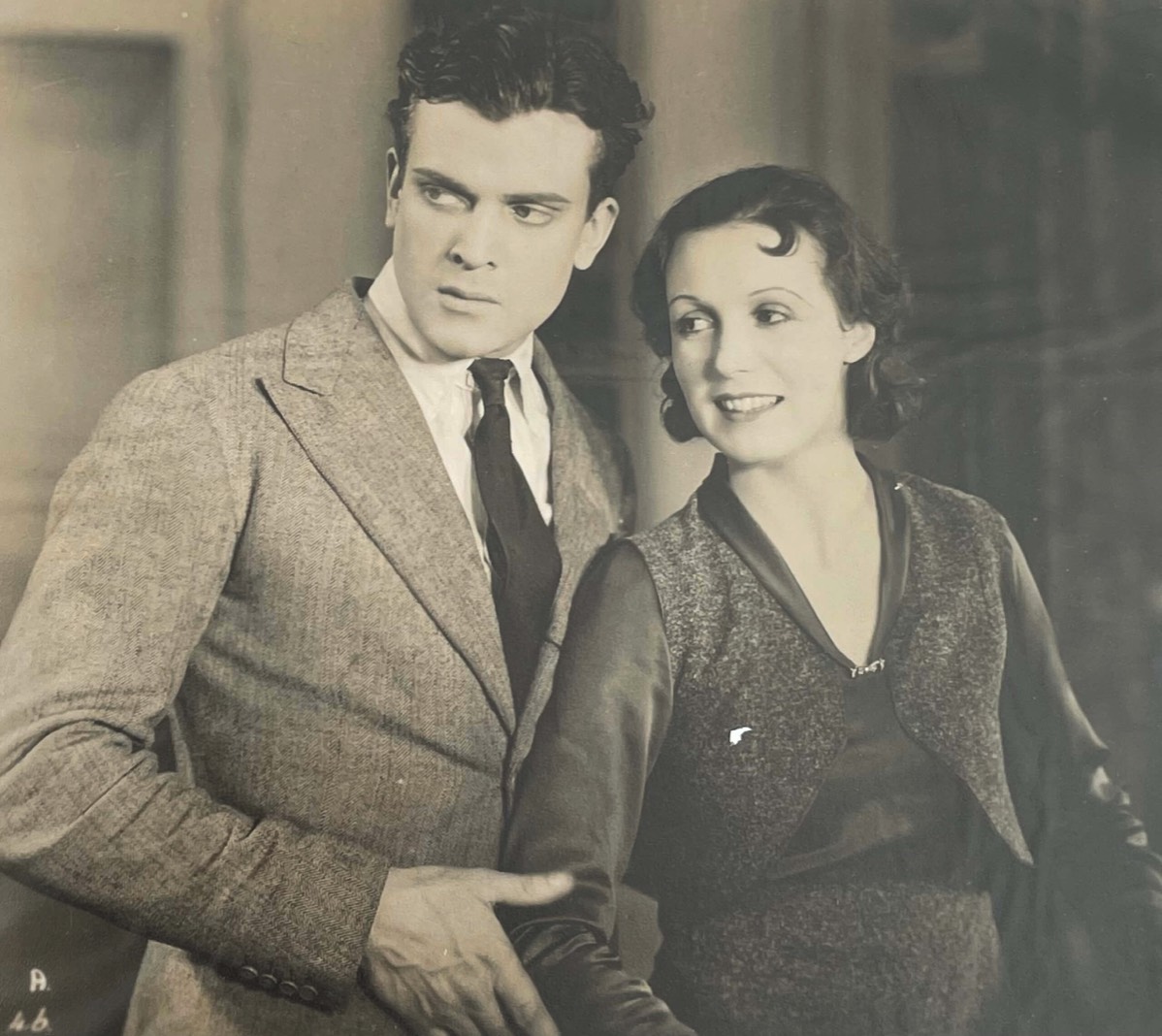
Years later, in 1944, John Longden and Esmond would appear together again in The Silver Fleet when Esmond was still totally blind after his wartime injury. Longdon's voice may be familiar to those who remember with fondness his narration of the opening scene of Powell & Pressburger's A Matter of Life and Death. ("This is the universe … big isn't it.").

(Picture courtesy of Alamy Images)
(Left) A candid photograph taken on the set of Deadlock (1931) with Esmond, Alma Taylor and Hay Plumb. The plot actually involves a murder that takes place in a film studio! Interestingly, this was filmed at Nettlefold Studios in Walton-up-Thames, formerly known as Hepworth Studios, one of the pioneer studios in the UK founded by Cecil M. Hepworth in 1899. Both Alma Taylor and Hay Plumb had been regular actors working for Hepworth since the early 1900s. Alma featured in a string of hugely popular shorts as "Tilly the Tomboy" in partnership with Chrissie White - a pair of naughty schoolgirls who got up to all sorts of mischief. Ironically, after a long career, one of Alma's final performances was in Blue Murder at St Trinians (1957), though not as a schoolgirl!
On stage in early 1931, Esmond appeared in Rahere, a play about the man who founded St Bartholomew's Hospital in London and built the great church in Smithfield where the production was staged. Then he found himself out of work again. During these periods of unemployment, it was his habit to escape to the country, usually to see his Uncle Chas. This time he helped Chas make a film about rare birds and animals which was often slow work and resulted in barely a few feet of film at the end of a long, arduous day. After one such day, Esmond arrived back at Chas's cottage in Sevenoaks to find a telephone message from Peter Godfrey, with whom he had worked at the Gate Theatre and spent some time with that summer on his motor boat. Peter invited Esmond back to the Gate to join the cast in a new production of Oscar Wilde's Salome. As the Young Syrian, Esmond had to kill himself early on in the play, but his body stayed on stage for some time. Fortunately he managed to arrange his death so that only his bottom half remained visible to the audience while his top half enjoyed a cigarette and a quiet chat with the stage manager!

The Bystander magazine on 28 October 1931 reports on Fran and Esmond arriving at the
Grosvenor House Hotel, Mayfair, ahead of a "Merrie England" Ball. No doubt Uncle Chas
had a hand in the occasion if goshawks and falcons were involved!

(Image reproduced by kind permission of the
Governing Body, Westminster School)
Meanwhile back at his alma mater, Westminster School, Esmond's former house, Home Boarders, had formed a Dramatic Society and wrote to Esmond seeking his advice and guidance on what to put on and how to produce it. He responded willingly and his suggestion of Oscar Wilde's The Importance of Being Ernest was taken on board. Both he and Fran were proactively involved throughout the production, including attending most of the rehearsals. The three performances in March / April 1931 were deemed a great success and this was the start of an annual event that lasted until 1935 with Esmond involved more often than not as professional commitments allowed. Another old boy who had become an actor, Michael Shepley, was also involved, and the following year they jointly produced Loyalties by John Galsworthy, a play which did much to expose antisemitism within the English upper-class in the 1920s.
By July he was out of work again. Then, quite by chance, he bumped in to an actor friend who told him about auditions taking place that very day for a new musical play about the Strauss family called Waltzes From Vienna. Esmond hurried along to the theatre where the auditions were being held, bluffed his way on stage, and the next day was engaged to play a small part and understudy Denis Noble at the enormous salary of £15 a week. Six days before they opened, the actor booked to play the leading role of Johann Strauss Junior withdrew, and to his delight Esmond was offered the part. It was the break in a large mainstream West End production he'd been seeking for a long time and he could hardly believe his good fortune. This was of course a musical, and the part of Johann Strauss Junior required him to sing as well as conduct a large orchestra on stage. He worked hard to make sure his musicianship was up to scratch and he did not let the producers down. Unbeknown to them, he'd been secretly learning the role in the hope that a chance such as this might occur.
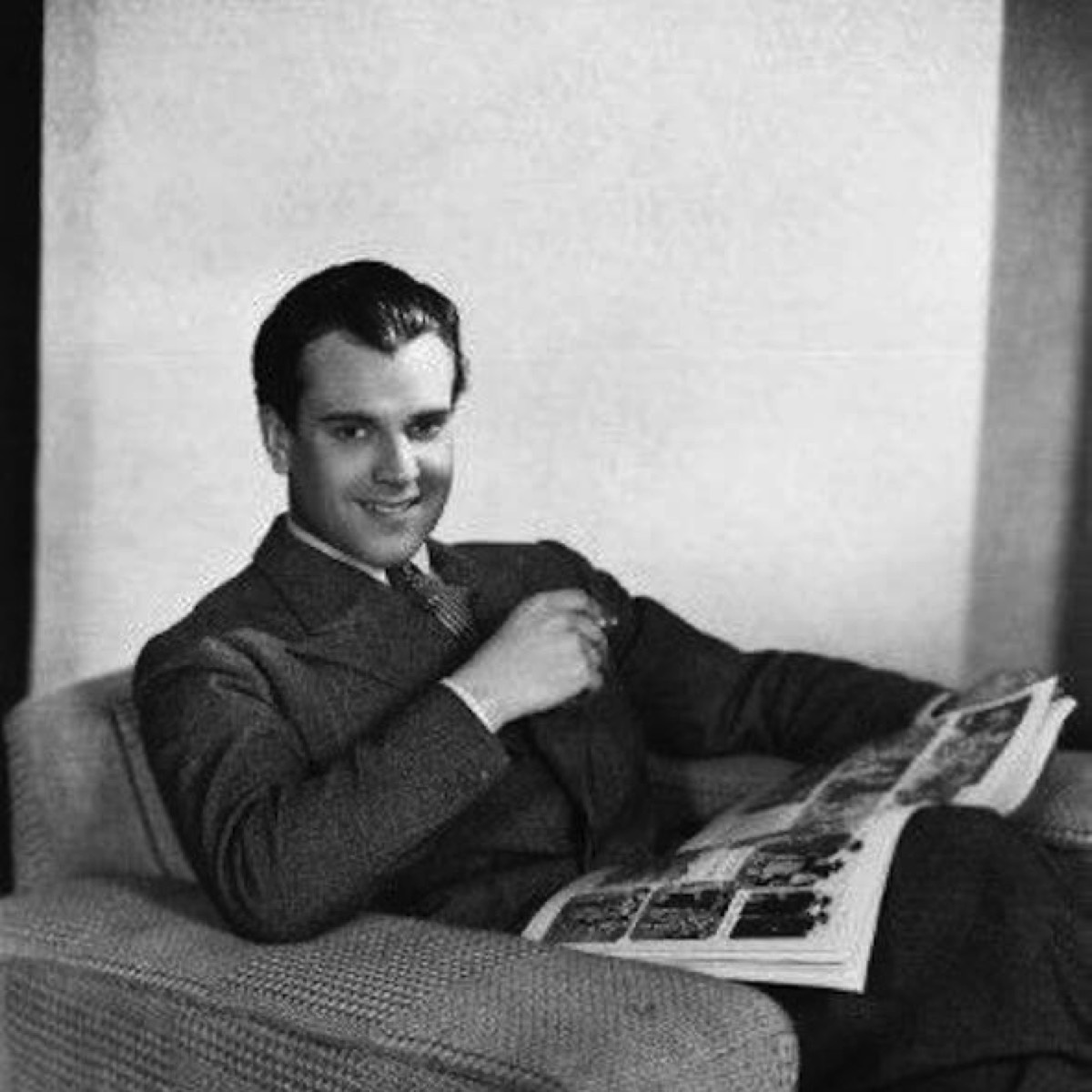
A publicity shot of Esmond taken in the mid-1930s.
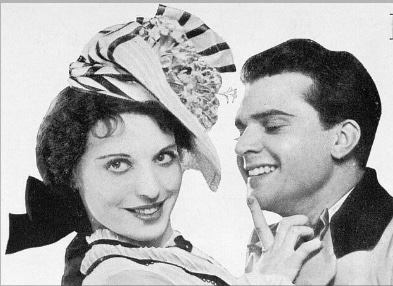
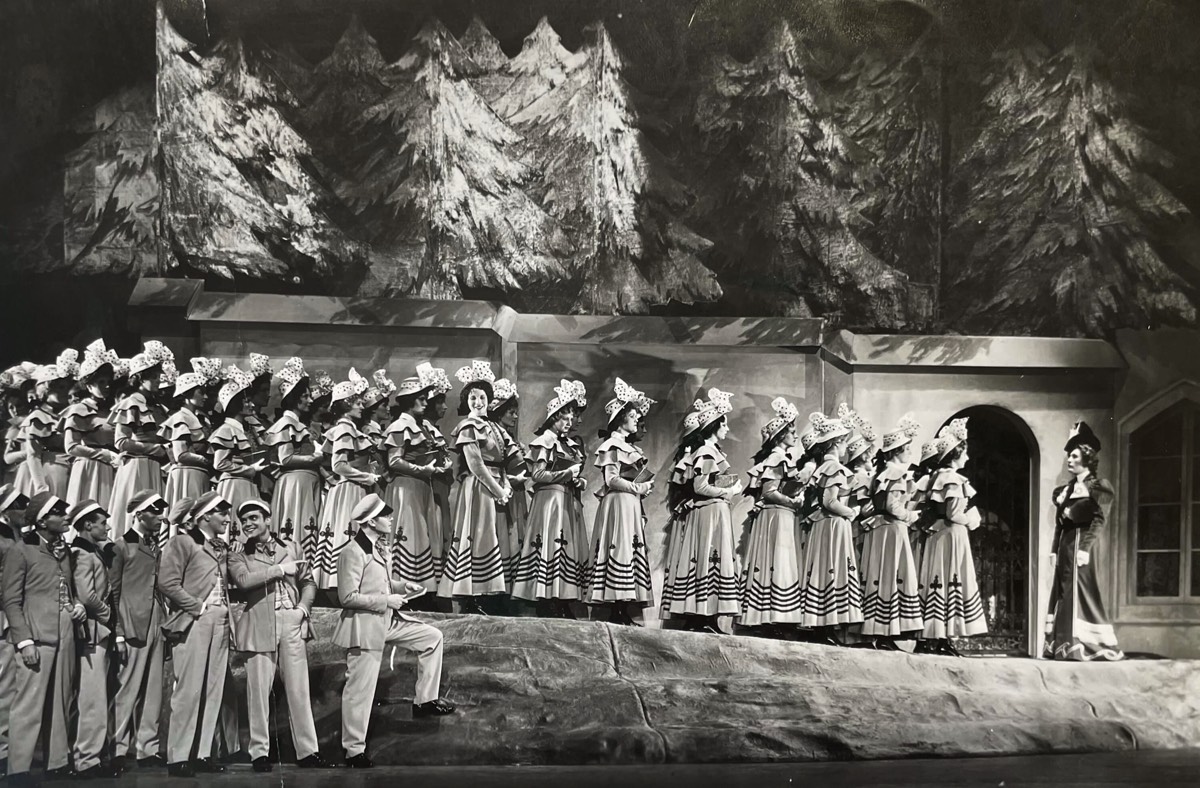
(Images from Wild Violets reproduced strictly under licence and with the permission of the University of Bristol / Theatre Collection)
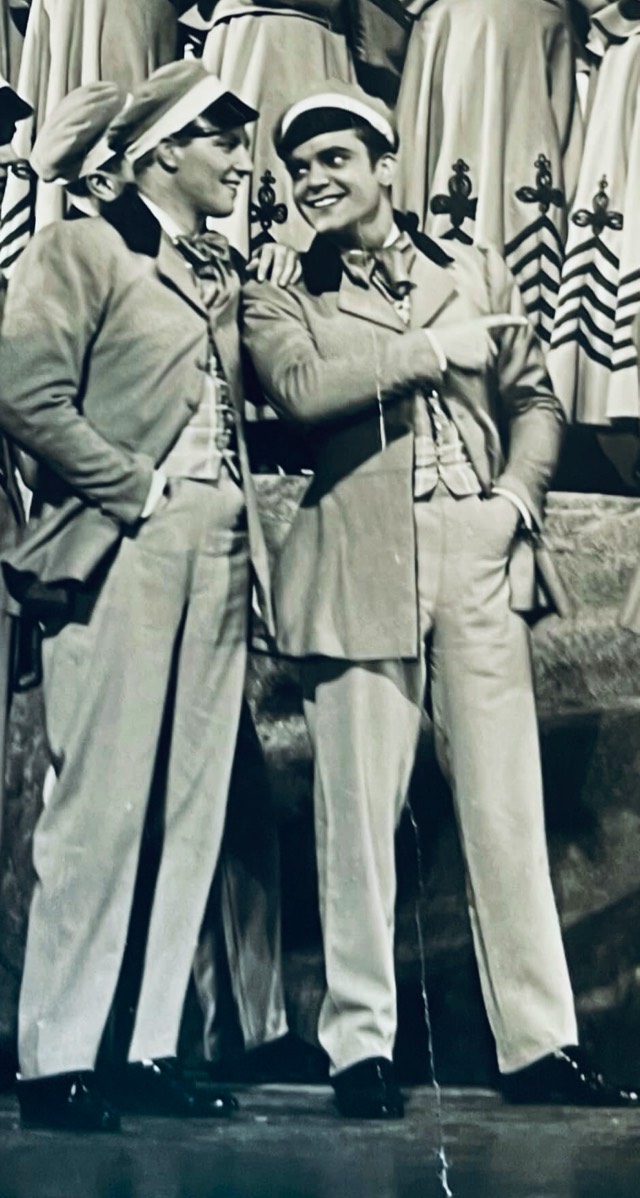
A scene from the lavish production of Wild Violets which started its run in October 1932 at the Theatre Royal,
Drury Lane, then toured major UK cities. Esmond played Otto Bergmann - you can see him (bottom left)
in the main picture chatting impishly with another cast member (name unknown).
As the run of Wild Violets came to an end, Esmond was cast by Warner Brothers as a boxer in a film called The Bermondsey Kid. It turned out to be, quite literally, a bruising experience as most of his opponents in the ring were genuine boxers, including the middleweight champion of England, Henry Mason, who knocked Esmond out twice for real as they shot the final fight sequence. Esmond attended the opening night with eyes half closed, swollen lips and a flattened nose. Warner Brothers then put him under contract and their managing director, Irving Asher, decided to promote him as a British James Cagney, although ironically his second film for them was as a dashing Italian pilot in The Blue Squadron.
As Eddie Martin in The Bermondsey Kid (1933), the film that won him a contract with Warner Brothers.
Picture courtesy of The British Film Institute


Charles Laughton and Elsa Lanchester (as Anne of Cleves) on their wedding night in the 1933 film The Private Life of Henry VIII.
Meanwhile, Esmond's Uncle Chas had been approached by Alexander Korda's company, London Film Productions, with a view to providing some hawks for a falconry sequence in their new film, The Private Life of Henry VIII, starring Charles Laughton (as Henry), Merle Oberon, Elsa Lanchester and Robert Donat. After initially refusing because he felt it would be impossible to produce the authentic number of hawks with which Henry VIII would have gone hunting, Chas Knight then enlisted his nephew to help train a number of different types of birds (falcons, tiercels, merlins) for the scene, and after much hard work they did so very successfully. They aimed for authenticity as much as possible, with the hawks wearing period hoods, jesses, bells and leashes and perched on an authentic frame (a "cadge") upon which they would have been carried in Tudor times. Both Chas and Esmond acted as falconers during the filming, which Alexander Korda directed himself. In the final edited film, the falconry sequence was not very prominent, providing merely an element of Tudor colour.
The Knights' work went uncredited. Nevertheless it was an enjoyable experience for Esmond and gave him an opportunity to indulge in one of his great passions at a professional level. And it was gratifying for him that the film was an enormous success, especially in the USA. The film premiered to record-breaking crowds at New York's Radio City Music Hall as it had at London's Leicester Square Theatre (now the Odeon West End). It also cemented Korda's career and he was signed by United Artists for sixteen more films. It was additionally memorable as the first non-Hollywood to win an Academy Award Oscar - best actor for Charles Laughton.

A signed 1930s "camera study" of Esmond with a falcon.
(Picture courtesy of Rosalind Knight)