On 3rd September 1939 Esmond heard Neville Chamberlain’s radio broadcast declaring war on Germany as he stood with Fran overlooking London at their St John’s Wood flat. He had been on stage in Edinburgh the night before with the Wilson Barrett Company and arrived home only hours before the historic broadcast at 11.15am.
Rosalind had already been evacuated with her nanny to Hatfield Heath, Essex, and from there they later moved to Sutton Scotney, near Winchester in Hampshire. There was nothing else for Esmond and Fran to do but try and keep on working, despite poor attendances at just about every theatre in London. On 2nd September, in the Middlesex Chronicle, an advert announced that the Barrett / Knight Company would return to the King's Theatre, Hammersmith, after a successful nine-week summer season in Edinburgh "… and will remain there until they make way for Kings Pantomime in December." But world events required flexibility to say the least. Esmond soon found himself back in Edinburgh, playing for a while in another Ivor Novello production, Full House, ironically to half empty houses. He and Wilson Barrett then tried touring instead with a play called You Can’t Take It With You, but this too soon fizzled out, as did the season as a whole. Eventually, after a successful production of Private Lives for which he received excellent reviews, Esmond returned to London in October. Professionally nothing much happened for him during the last months of 1939 and the general feeling was that “… the theatre was finished and done with for the duration.”
At first the same was true of the film world, with Alexander Korda transferring completion of The Thief of Baghdad from Pinewood Studios to Hollywood. Director Michael Powell had other ideas, however, and in January 1940 Esmond was at Denham Studios filming Contraband, a comical spy thriller starring Conrad Veidt, Valerie Hobson and a host of familiar faces including Hay Petrie, John Longdon, Raymond Lovell, Eric Berry, Leo Genn, Peter Bull, Esma Cannon, Michael Shepley, Bernard Miles and Peter Bull. It's delightfully tongue-in-cheek and Esmond shines as Mr Pidgeon, an enigmatic character of few words, supposedly a theatrical talent spotter but with hidden depths. When the film was finished, he took a short holiday in Cornwall with Powell before returning to London to complete an obscure film called Fingers at Teddington Studios.

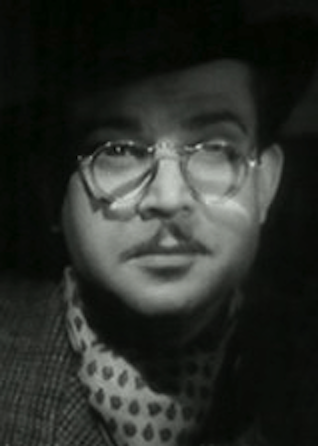
(Left): A contemporary cinema poster for Contraband. Esmond played Mr Pidgeon (right) in this Michael Powell production
which helped to keep the British film industry alive during the uncertain early months of World War II.
At the suggestion of his old friend Vernon Sewell, Esmond had applied for a commission in the Royal Naval Volunteer Reserve (RNVR) and, with little work in the pipeline, he waited anxiously for his call up letter to arrive. Meanwhile Wilson Barrett was struggling to keep something happening on stage and since January had been managing a second London season at the King's Theatre, Hammersmith. Esmond joined the company whenever he could and appeared in four productions - The Importance of Being Earnest, Through The Night, The Peaceful Inn and Goodness How Sad!. (In 1944 Esmond appeared in the film version of The Peaceful Inn, re-titled for cinema as The Halfway House).
Meanwhile, as an aside from the war and the anxiety it brought, Scottish painter Alexander Christie added Esmond to his list of subjects and produced a magnificent portrait of him holding a falcon and wearing traditional falconer's dress - true to one of the great passions of his life. The picture was later used as the frontispiece for Esmond's 1943 autobiography Seeking the Bubble. Christie met Esmond socially prior to the commission - both were member of the Arts Theatre and Chelsea Arts Club. Actors were regular subjects - others included Yvonne Arnaud, Ernest Thesiger and Peggy Ashcroft. The portrait of Esmond was subsequently purchased by Lord Fairhaven, a wealthy Anglo-American philanthropist and art collector, and hung at Anglesey Abbey, the Cambridgeshire home he shared with his brother - now owned by the National Trust. An enquiry in early 2026 confirmed that they no longer have the portrait; its whereabouts is unknown.

(Above) - with artist Alexander Christie whose portrait of Esmond he had recently painted and was on display at an annual exhibition by the Royal Society of Portrait Painters in London - November 1939.
(Image source - the British Newspaper Archive)

One of the four plays Esmond appeared in at the King's Theatre, Through the Night, premiered on 1st April 1940. Here (left) Esmond plays a scene with George Larchet who also appeared in First Stop North and Night Must Fall. The following month, Germany invaded France and the Low Countries, and the war began in earnest. The British Army soon found itself in rapid retreat towards the French coast and the danger of invasion seemed all too real. Seeing plays was no one's priority and almost every theatre in London closed. As a last ditched attempt to continue working, Wilson Barrett and Esmond took the Duke of York's Theatre towards the end of May and transferred there with their production of The Peaceful Inn. They chose it for its hopeful message, something that might appeal to the moment. But even with the attraction of a star guest performer joining the cast (Nora Swinburne no less) it ran for only a handful of performances. With no work, and to help pass the time until his call-up, Esmond went to stay with his Uncle Chas in Kent, and briefly joined the Local Defence Volunteers, soon to be renamed The Home Guard. As British troops were being rescued from the beaches of Dunkirk across the English Channel, Esmond helped Chas train locals in map reading and use of all manner of improvised weaponry including some longbows they happened to own. He became fascinated by the power and precision of archery, an interest that would manifest itself to an even greater degree on stage thirty years later. One of Esmond's particular contributions to the training was to cut out from cardboard a life-sized German soldier which was erected on the firing range as a target of special appeal to the volunteers.
(Photo [left] of Through the Night reproduced strictly under licence and
with kind permission of the University of Bristol / Theatre Collection)
When Michael Powell returned from a trip to Canada where he had been researching a film, 49th Parallel, sponsored by the Ministry of Information, he was frustrated to learn that Esmond had committed to joining the RNVR. He badly wanted Esmond to play a lead role, that of the Nazi Lieutenant Hirth, in this story of German sailors escaping across Canada after their U boat has been sunk in Canadian waters. Powell tried to pull some strings and have Esmond's call-up postponed until after the film had been shot, but without success. The role of Hirth went to Eric Portman who, it has to be said, did a superb job.
Eric Portman (on the right) as Lieutenant Hirth in 49th Parallel (1941), the role intended for Esmond. Here Hirth threatens to kill Raymond Massey in a box car straddling the USA / Canada border at Niagara Falls.

Photograph courtesy of Steve Crook
In his autobiography, Michael Powell wrote:
"From the moment of Hirth's creation by Emeric, I had planned that this fanatical Nazi, second-in-command on the U-boat, should be played by Esmond Knight … It was his performance as Angel in What Men Live By, the little film I wrote for
Vernon Sewell in 1937, that convinced me he had that extra something that a good actor needs to dominate the screen.
It only needed a good part to being it out, and here, at last, I had it for him. To my dismay, when I returned from Canada,
I found that he had joined the Royal Navy at the urging of Vernon Sewell, which was all very well for Vernon, with his sea experience in small ships, but quite another for Esmond who would get his training in big ships. I tried to postpone the
enrolment until the film was made, but the times were too desperate for this kind of arrangements."
Fran had managed to find work touring in a new play by J. B. Priestley, The Long Mirror whilst Esmond, still waiting for
“that letter”, left Kent and went to stay with her in Scarborough and then Eastbourne. Back in London he joined the cast of A Midsummer Night’s Dream at the Open Air Theatre in Regent’s Park which was to be his last stage performance for four years. "The Battle of Britain had begun, and as I woke from a pleasant sleep on the greensward, stuttering the words, 'My lord, I shall reply amazedly, half asleep, half waking,' I could see, through the trees to the east, an enormous column of yellow smoke rising thousands of feet into the air. The Germans had bombed the Docks."

Photograph courtesy of Rosalind Knight
A candid press photograph of some of the cast of A Midsummer Night's Dream taken in Regents Park in August 1940.
Esmond, who played Lysander, is walking alongside Margaret Vines in costume as Titania. At this point in time he
had been accepted by the Royal Navy Volunteer Reserve and was counting the days until his call-up papers arrived.
The Knights had by now moved out of their flat in St John’s Wood, put their furniture into storage and rented rooms in a house in nearby Gloucester Place. Here the waiting continued as the blitz began to take hold with nightly bombing raids over London. Money was running low but fortunately Esmond managed to gain a part in a film called This England (retitled Our Heritage for release in Scotland), a story about past attempts in history to invade Britain. He played an Elizabethan youth who pined to go to sea with Drake to fight the Armada. The morning after a heavy air raid, his brother Gilbert, who was working as a cameraman on the same film, drove him on the back of his motorcycle to the studios, taking regular diversions to avoid unexploded bombs and the debris of direct hits.
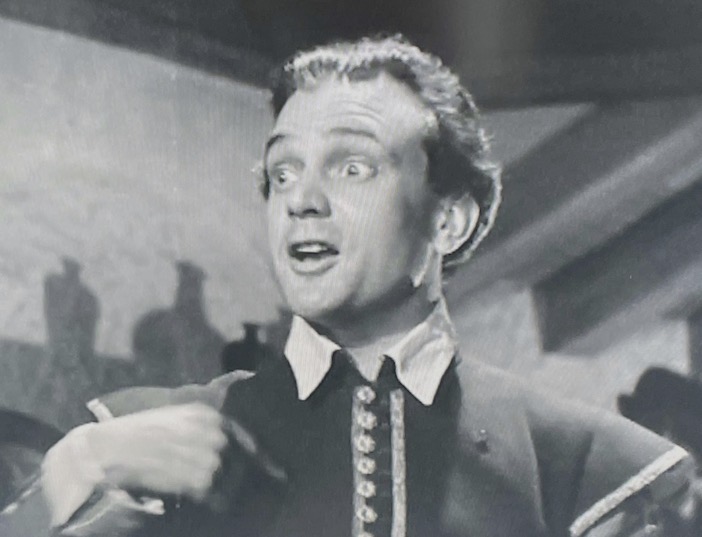
In his autobiography Esmond wrote: "In This England I had a line to say: 'I wish before heaven that Master Francis Drake
would send me abroad and into battle!' - and since this expressed exactly what I was feeling at the time, I got it off my chest
with gusto and my prayer was answered, for that night I received the long-awaited letter - just as sirens sounded again."
The letter arrived on Friday 13th September 1940. Six days later Esmond arrived at HMS King Alfred in Hove, Sussex, to undergo basic training. He then hoped to serve on M.T.B.s but soon realised that he was too old: “One has to be young to withstand the violent jolting to which one’s intestines are subjected in M.T.B.s!”. To get appointed to a big ship he needed to special qualifications as a High Angle Control Officer, so he transferred on to gunnery courses at HMS Drake in Plymouth and Whale Island in Portsmouth, passing the exams with ease. It was now December and he was given leave until after Christmas whilst awaiting his first posting. Fran was in Edinburgh appearing with Ivor Novello in his own show, The Dancing Years, so Esmond decided to join her there. On the train, by chance, he bumped into Ivor Novello himself and they travelled up to Scotland together.
On 27th December 1940, Lieutenant Esmond Knight, RNVR, Gunnery Officer, received orders to report to Birkenhead, near Liverpool, where he had been appointed to join a brand new battleship - HMS Prince of Wales.