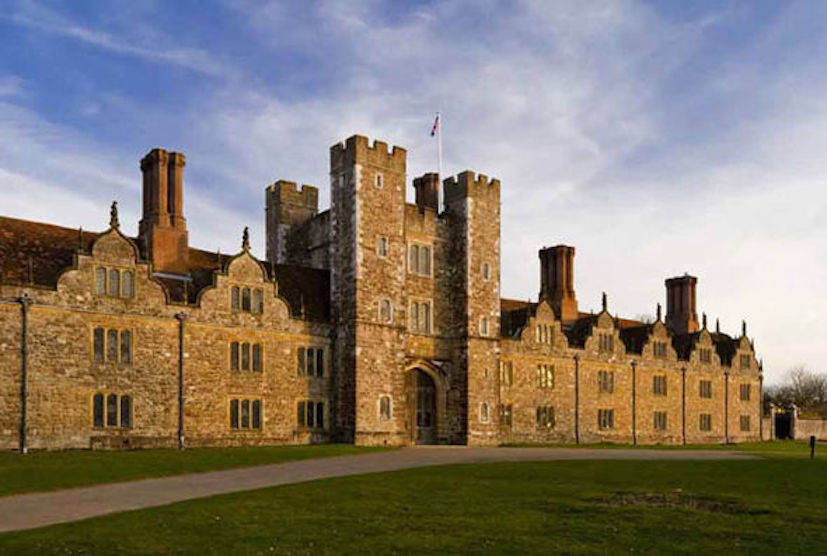
On his return to England from Spain, Esmond discovered the part he'd been promised (sort of) was in a film to be shot in Germany, and that it was not yet certain, despite having made a screen test and met the director, Paul Martin. He was out of work again, so he and Fran went to stay with Florence Desmond, his co-star in Streamline, and Tom Campbell Black, and from there they travelled to Kent to see Uncle Chas who was making a film about falconry. They found themselves filming in the grounds of Knole House (pictured left), with Esmond playing the part of a poacher. It was one of many projects that turned into a Knight family production and a useful foil in between professional engagements. He later wrote:
"When I was 'resting', as the old actors used so charmingly to put it, I did at least learn to know a hawk from a hand-saw, to shoot with a sporting gun, and to handle a moving picture camera."
John Tyrie, a friend of the Knight family, recalls an occasion when Esmond was very nearly genuinely caught poaching. John, Esmond and Chas were out shooting one morning in the grounds of a convent, on private land where they should not have been. When an irate nun confronted them in the woods, Esmond immediately went into "acting mode" and managed to convince her they were doing an enormous favour by shooting squirrels which were a huge pest. The truth was that they were shooting all kinds of wildlife, but Esmond's performance succeeding in placating the nun. When she had gone, he came out of character and gave a huge sigh of relief!
Eventually Esmond heard that the part in the film being made at U.F.A. Studios in Germany was his and he found himself on board a Junkers aircraft bound for Berlin. The film was called Schwarze Rosen (Black Roses) and he was to star alongside Lilian Harvey, a British actress who had been making films on the Continent for many years. As with 77 Park Lane at Nettlefold Studios a few years earlier, three versions of the film were being made simultaneously - this time with English, German and French casts. To add to the highly international flavour, the storyline of the film was based in Finland and Esmond played the part of a patriot who organises a rebellion against the Russians. The English version was eventually released in 1937 under the title Did I Betray?

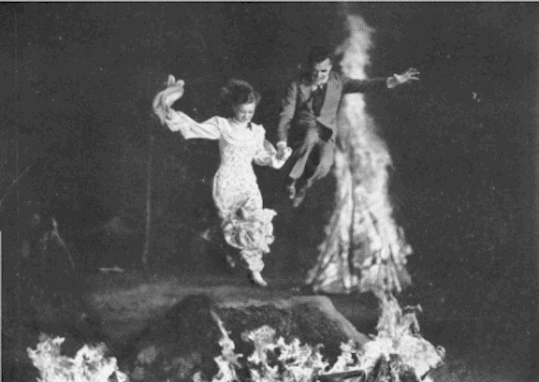
(Above) An athletic Esmond with Lilian Harvey, jumping for happiness (an old Finnish custom apparently) in a
scene from Schwarze Rosen (Black Roses).
(Left) Lillian with her three leading men: Jean Galland (French),
Willy Fritsch (German), and Esmond (English).
(Left photo courtesy of Alamy Images)
Lilian Harvey, with her flair for languages, was involved in all three versions whereas Esmond only featured in the English one. When he wasn't required at the U.F.A. Studios on the outskirts of Berlin, he spent his time sightseeing, visiting museums and art galleries, going to the theatre and observing first hand the heady and often sinister world of Nazi Germany. On one occasion he saw Hermann Göring in a hotel bar and on another, Julius Streicher, publisher of the Nazi newspaper Der Stürmer, came to see filming in progress. By this time all Jews had left U.F.A. and soon the studios would become entirely state controlled.
Fran joined him for some of the time on her way back from a trip to Budapest with the BBC. He also bumped into some old friends in Berlin, including an old rowing friend from Westminster School, now a diplomat at the British Embassy. Another friend, Eric John, later recalled a conversation with Esmond as they sat on the roof of the Eden Hotel:
You're a lucky man," I murmured. "Here you are living like a lord in one of the most interesting cities in Europe and it's not costing you a penny. They're actually paying you to make love to Lillian Harvey by day and to fall in love with Berlin by night. There are times when I feel you actors get the penny and the bun!"
"Perhaps we are a bit spoilt when we're working," conceded Esmond, "but our year doesn't add up to fifty-two weeks."
"It's not the most stable of professions," I admitted … adding a pause. "Have you ever thought what you would do if for some reason you were compelled to renounce acting as a career?"
Esmond thought for a moment as he contemplated the steady stream of traffic purring along under the trees towards the Kurfürstendamm, centre of Berlin's night life. "Oh I don't know," he replied, with that characteristic little nervous laugh of his. "I think I'd like to mess about with cars."
Eric John wrote these words in an article ("Defeatism Defeated" - Theatre World magazine, April 1942) at a time when Esmond might indeed have been compelled to put acting behind him.
Esmond returned to England with a healthy bank balance, though he nearly forfeited some of his earnings en route. Arriving at Croydon Airport he omitted to declare some gifts he'd bought for various people, having concealed them in his luggage. Unfortunately for him, an efficient customs officer made a thorough search and retrieved them. In an inner office, a senior officer emphasised the seriousness of the offence and warned him he was liable to a hefty fine or even imprisonment. "No good being a bad actor for nothing," Esmond thought to himself and proceeded to perform a heavy apologetic 'act'. It worked. He was let off and ordered to pay just the duty. (It wasn't his only run-in with the law that year. In August of 1936 he was summoned for speeding at between 40 and 45 m.p.h. in Burlington Lane, Chiswick, West London. He was fined 40 shillings.)

(Picture courtesy of Alamy Images)
By the mid-1930s, Esmond's Uncle Chas had developed a regular spot on the American lecture tour circuit and was crossing the Atlantic frequently, often several times a year, and always with a raptor of one form or another which attracted huge crowds to his talks and demonstrations from coast to coast. By far the most popular of these was his golden eagle, Mr Ramshaw. The two are seen here (left) at Southampton docks returning from a tour in 1936 and being welcomed by Esmond who appears to have brought a falcon along to greet them. Uncle Chas and Mr Ramshaw were immortalised some years later by Michael Powell and Emeric Pressburger in their 1945 film I Know Where I'm Going - Uncle Chas as the eccentric Colonel Barnstable and Ramshaw as his tame golden eagle, Torquil. Ramshaw appeared in other films too, notably in the delightful Geordie (1955) starring Alastair Sim and Bill Travers.
After his experience filming Black Roses, and seeking work in the theatre, Esmond was determined to lose his reputation for musical comedy and return to straight roles - "the legit, as the older professional school describe it". His initial opportunity, playing Byron in Bitter Harvest, came in early 1936 but was scuppered by an attack of jaundice which sapped his confidence and ambition almost to the point of despair. (The role was taken over by Eric Portman.) Fortunately another opportunity soon materialised in a short run of Little Ol' Boy at the Arts Theatre (in which Fran also appeared) and then, more significantly, as The Parasite and The Ant Commandeer in The Insect Play at the Playhouse Theatre. This deeply satirical work by the Czech writer Karel Capek was precisely what he needed and although the salary was poor, the production not only restored his self-confidence but also redirected his career the way he had hoped. And very positive reviews helped enormously. It also gave him the chance to work for the first time with Robert Helpmann who played Mr Cricket and Chief of the Yellow Ants.

Whilst still in The Insect Play, Esmond went along to the Duchess Theatre to see Emlyn Williams' tense psychological thriller, Night Must Fall, with Williams himself playing Danny (Dan), a baby-faced murderer, with a view to taking over the part which would enable Williams to take the play to New York. This came to fruition and Esmond, like Williams before him, made a great success in the role, now at a new venue, The Cambridge Theatre. Initially Esmond, in an effort to avoid simply imitating Williams' very Welsh performance, experimented with playing the role as a Cockney. But he soon began to appreciate that much would be lost from the part by doing so and he proceeded effectively to "understudy" Williams as precisely as he could. He grew to love the part and was very comfortable playing Dan, especially as the production was expertly handled by his old school friend, Glen Byam Shaw, who had taken over from the original producer, Miles Malleson. Esmond's Welsh accent improved greatly over time. After the first performance, a London critic wrote: "Knight must fall unless he learns to speak better Welsh." But later on during the run he received a letter from a Welsh woman who had seen the play asking which part of Wales he came from! In fact, Esmond became something of an expert in playing Welsh characters (Fluellen in Henry V, David Davies in The Halfway House) and was referred to more than once by film critics in the press as 'a Welsh actor'.
Cast list from the programme for Night Must Fall in which Esmond played a 'baby-faced' murderer. Note a young Patricia Hayes in a small role as a maid.
Both London productions of Night Must Fall were hugely popular and ran for a total of 436 performances. (Less so in New York where the run was comparatively short - 64 performances.) It has been revived numerous times since including in 1996 with Jason Donovan as Dan; the reviews were poor, not least for his attempt at a Welsh accent. There has also been a film version (1964) with Albert Finney as Dan.
Whilst on stage in Night Must Fall in the evening, Esmond was busy during the day on a film set making Pagliacci, a cinematic version of Leoncavallo's operetta, in which Richard Tauber not only sang the arias of his own character but several others as well. The film opened on 11th December 1936 and Esmond remembers, on the same night, hearing Edward VIII's abdication speech in a radio broadcast to the nation. Meanwhile he was tempted away from Night Must Fall, unwisely as it transpired, by the opportunity to play Richard III (or "Dickie Three-Eyes" as he is known in some theatrical circles) in a new play called The King and Mistress Shore at the Little Theatre (part of the Adelphi). It only ran for a fortnight and during one performance his co-star, Joan Maude, tripped over backwards, bringing Esmond with her. As he fell, his tights ripped from top to bottom and he was forced to play the rest of the act facing "out front".
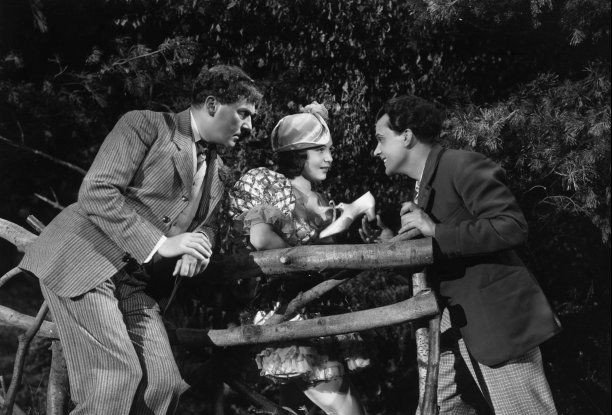
A scene from the light operetta Pagliacci which Esmond
(far right) filmed by day whilst performing on stage at night
as a murderer in Night Must Fall.
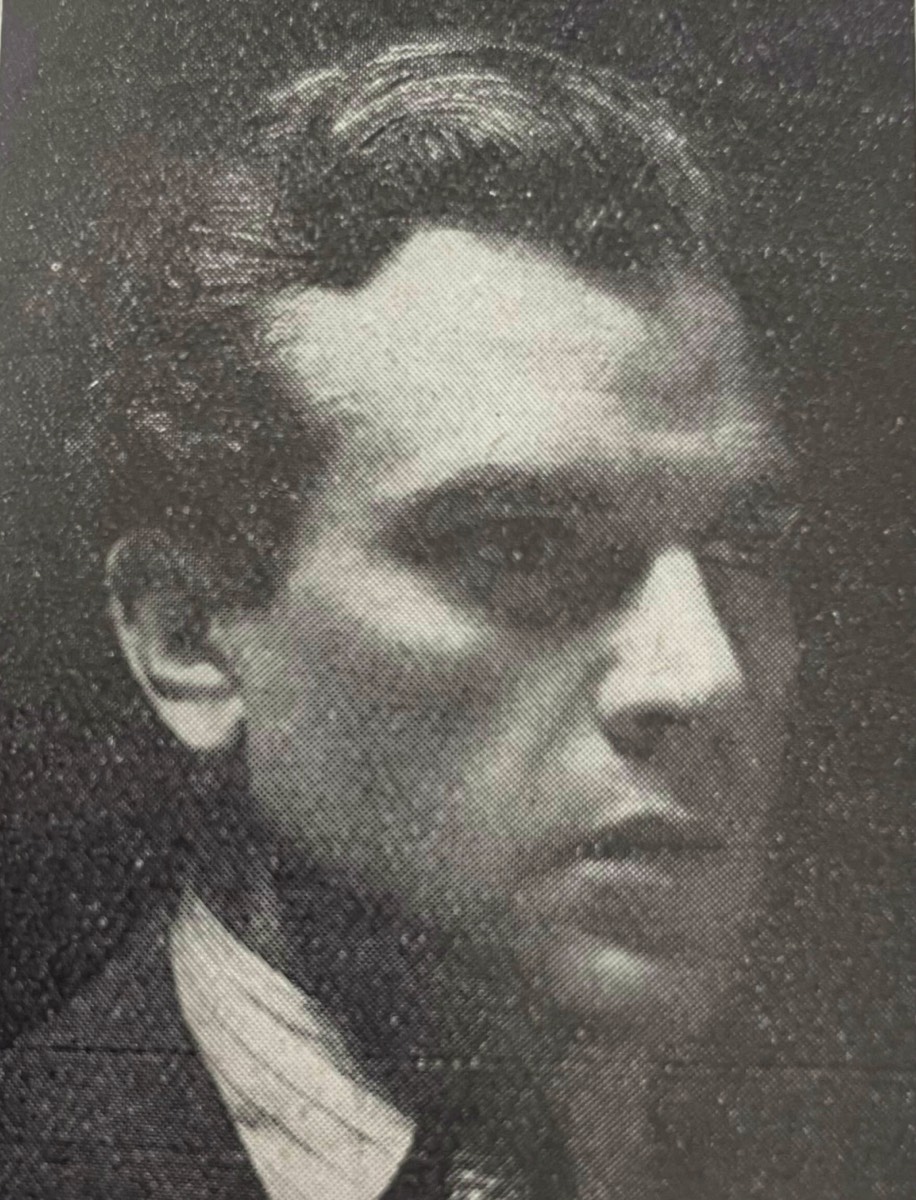

Two portraits taken from 1936 theatre programmes - (Left) The Insect Play in which Esmond played The Parasite and
The Chief Engineer, and (Right) The King and Mistress Shore in which he played Richard, Duke of Gloucester.
(Centre) A scene from The King and Mistress Shore with Esmond as Richard and the young princes (Edward and
Richard, played by Sandy Williamson and John Hepworth) whose fate will ultimately lie in Richard's hands.
Fate was playing a hand, so it would seem. Had Esmond not left the successful run of Night Must Fall and found himself suddenly available again after just two weeks in The King and Mistress Shore, he would not have been free to join the cast of Wise Tomorrow, initially at the Garrick Theatre in Stockport then on to the Lyric Theatre in London, in early 1937. And if he had not done so he would not have met and shared the cast with Nora Swinburne, who later described their meeting:
"I went to the first rehearsal looking, I felt, my best. Having got there early, I waited at the side of the stage, sitting on a chair behind a flat where I could see but not be seen. I saw one or two of the cast arrive and was just about to show myself when a young man passed me. He wasn't very tall, slim, extremely good-looking with brown wavy hair and wonderful blue eyes. I had a good look at him. 'Whoever lived, that loved not at first sight?' as Marlow so beautifully puts it. After a few minutes I walked on to the stage and was introduced to the cast. Esmond and I met for the first time and I feel like singing, 'I took one look at you and then my heart stood still'.
"We had such fun rehearsing that play. Everyone was so nice and jolly. It was rather a strange play with a slightly unpleasant suggestion of lesbianism, quite risqué at that time. I had to fall in love with the hero, which I did, lock, stock and barrel. I had a lovely scene over a piano where I had to gaze into his eyes and make him realise I was madly in love. I didn't find it difficult and I think he got the message. It was a sort of game, nothing was ever spoken. It was the happiest three weeks of rehearsal I have ever known."
And fall in love they did.

The opening scene of Wise Tomorrow - from left to right:
Nora Swinburne, Esmond Knight, Emma Frenchman, Archibald Batty
In their April 1937 issue, Theatre World magazine reviewed Wise Tomorrow: "Stephen Powys' play, well constructed and brilliantly written, is acted by one of the strongest casts in town. Martita Hunt gives a magnificent performance as the unpleasant Diana; Nora Swinburne and Diana Churchill are admirably contrasted as the two sisters; Naunton Wayne comes to the front rank of light comedians as the philosophical Norman; Esmond Knight is sincere and likeable as Peter, and Olga Linda makes a caustic and realistic figure of Colley. Archibald Batty, Beatrix Feilden-Kaye and Emma Trechman lend excellent support, and the play enjoys a polished and well-balanced production by Athole Stewart."

Wise Tomorrow was a reasonable success; the production lasted for several months during the first half of 1937. Although he regarded himself as miscast as a wealthy Englishman vying for the affections of a young actress, Esmond was not unduly perturbed; he was being paid a large salary to be on stage nightly with Nora Swinburne and an altogether fine cast. However, the capacity audiences anticipated during the coronation of George VI in May did not materialise due to a strike by bus drivers and, as in most other West End theatres, the cast unexpectedly found themselves playing to virtually empty houses. Nora and Esmond's affair started secretly, but in time Fran became aware and showed a remarkable sympathy and understanding of the situation. She liked Nora and valued her friendship, and rather felt that Esmond was in safe hands with her, in a curious way. But whatever the complexities of the circumstances, Nora became a permanent part of Esmond's life from this moment onwards and almost a decade later she became his second wife.

A signed illustration by artist Owen Ascroft of the cast of Wise Tomorrow,
the play in which Esmond and Nora Swinburne first met.
(Image source - the British Newspaper Archive)