
When the run of Wise Tomorrow came to an end in the summer of 1937, Esmond and Fran took off for a holiday in Austria with Esmond's parents where he again was able to observe the sinister influence of the Nazis, this time in the idyllic rural landscape of the Tyrol region. It was here that he purchased a pair of Zeiss binoculars which were to accompany him when he was called up to join the Royal Navy four years later. Esmond returned to England earlier than expected when he received an invitation to appear in a new musical show called The Laughing Cavalier. He was to play Franz Hals, the artist whose famous painting gave the show its name. But Esmond was not particularly impressed with the treatment given to his character and he soon withdrew from the production. Instead, ironically, he found himself playing an even more famous artist - Vincent Van Gogh. The writer was Dan McKenna (also known as Dan Burke) who had been a successful Irish jockey and decided to turn his hand to writing a play.
The result was Van Gogh, a play in seven scenes, which Esmond regarded as a remarkable achievement. "It was stark and virile writing, containing all the passion, colour and tragedy of the artist's vivid life. Dan McKenna was a wild and morose character himself, and, I think, became completely obsessed by the Van Gogh story . . ." The play charted the whole of Van Gogh's adult life including the incident in which he cut off his ear. Esmond came a little too close to realism during one performance, misjudging the fake stroke with a real razor and shedding real blood over the yellow furniture of the set. Ironically, whilst The Laughing Cavalier enjoyed a long run, there wasn't enough finance to present Van Gogh in the West End and despite glowing reviews it played for only four performances at the Arts Theatre Club. Depressed and disturbed, Dan McKenna was found drowned in a lake in Ireland not long afterwards.
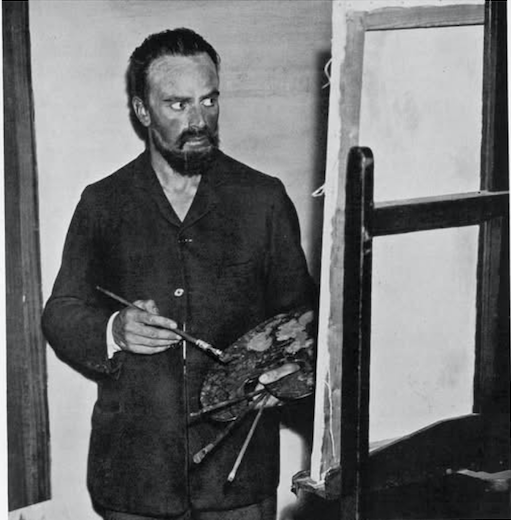

(Left) Esmond in character as the eponymous lead in Dan McKenna's play, Van Gogh. (Right) Making up in the dressing room
of the Arts Theatre Club. Reflected in the mirror is Wilson Barrett who played Vincent's brother, Theo.
There was a little more mileage to be had from the project, however, which brought Esmond into contact for the first time with an additional and valuable source of work - the new media of television. In 1936 the British Broadcasting Company launched the world's first regular high-definition public broadcasting service from Alexander Palace, a former Victorian entertainment venue situated in north London. Former dining rooms were converted into television studios and a 213-foot antenna tower was erected. A shortened version of Van Gogh was broadcast by the BBC from Alexander Palace on 29th September 1937. The broadcast was live, naturally, and the action had to be limited to a small stage area in order to keep within the confines of narrow camera angles. Later the same year, Esmond repeated his part as the sinister character Danny in Night Must Fall for the BBC (broadcast 21st October) and during the next two years he was involved in a number of other broadcasts from "Ally Pally" until broadcasting was suspended for the duration of the war. The television service was abruptly shut down on 1st September 1939 and did not resume broadcasting until 7th June 1947.
Lorem ipsum dolor sit amet, sapien platea morbi dolor lacu
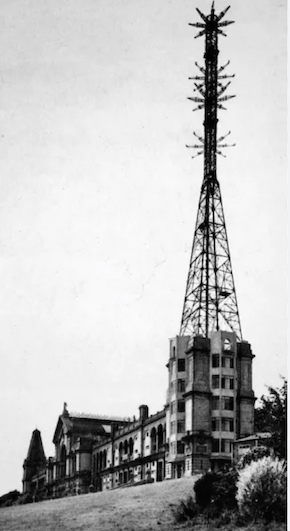
Alexandra Palace in 1936. From here Esmond took part in
some of the earliest broadcasts of plays for the BBC
including Van Gogh and Night Must Fall.

Regular film work was becoming difficult to find. He only made one film in 1937, The Vicar of Bray, a musical set in the Civil War period and based on the satirical 18th century song, with Stanley Holloway as a vicar who manages to retain his living under both King and Cromwell by changing his religion and allegiance to suit whoever comes to power. The chorus of the song is:
"And this is the law I will maintain until my dying day, Sir, That whatsoever King shall reign I'll be the Vicar of Bray, Sir!"
Although the film is set in Bray, County Wicklow, Ireland, the original song was about a certain vicar the village of Bray in Berkshire, England, more than 250 miles away.
The following year his old friend Vernon Sewell invited him to appear in an adaptation (by Michael Powell) of Tolstoy's What Men Live By, a story of a disgraced angel sent down to earth as a punishment. Esmond played the angel who initially arrives stark naked, a scene filmed with some personal discomfort in a Sussex wood in mid-winter! His performance impressed Michael Powell enough to make a mental note that as soon as an appropriate film project came his way he would offer Esmond a leading role. Unfortunately, the distributors were less enthusiastic about What Men Live By and the film was shelved until 1939 when it was eventually released in British cinemas … and very well received.


Esmond as an angel banished to earth - three stills from What Men Live By (1938)
When he saw Esmond's performance in this film (which he wrote), Michael Powell
knew he had the potential to carry a major role when the right part came along.
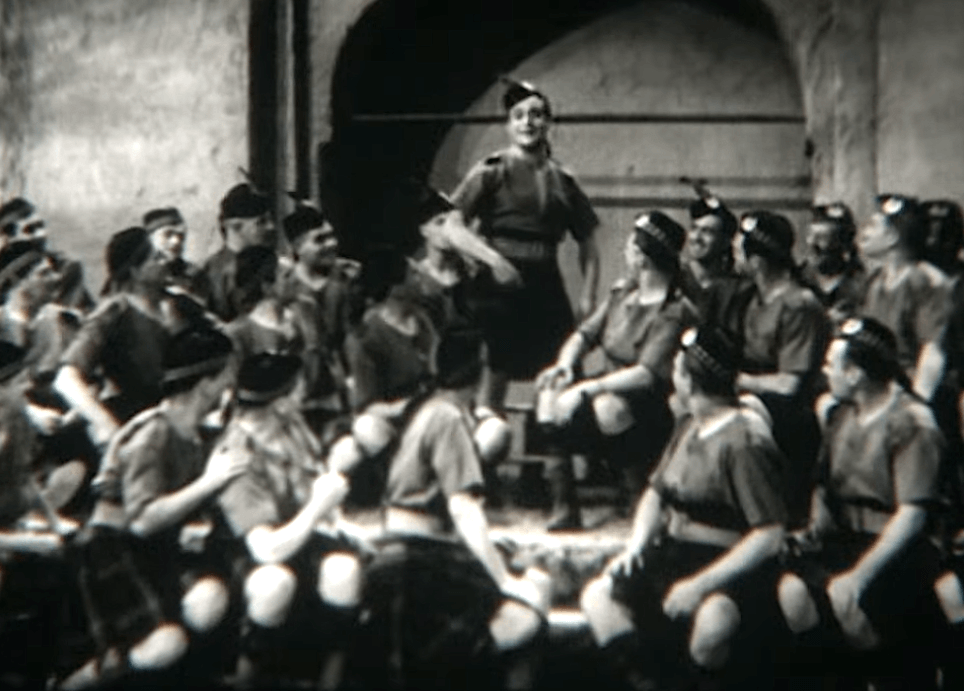
Years later, in 1949, while filming Gone to Earth in Shropshire, Esmond was interviewed by Roderick Mann for the Birmingham Daily Gazette. He mentioned to the journalist that he had once played a small, uncredited part in a film called The Drum which was released in early 1938. By all accounts this cropped up in conversation because the film was showing at a local cinema and so the two of them went along to see it. Esmond quipped afterwards: "I was quite good!" His brief appearance is as a soldier of the Gordon Highlanders who leads an impromptu traditional Scottish dance sequence (right).
He was indeed quite good!

In July 1938, Esmond took part in another of his Uncle Chas's productions - a film about eagles called Leopard of the Air. At that time Chas owned three magnificent eagles: Mr Ramshaw, a Golden Eagle; James, a Martial Eagle; and Coronation, a Crowned Eagle. For the sake of the film, he wanted to fly all three at once with Chas, Esmond and their friend Leslie Foyle releasing them simultaneously.
Flying three eagles for Chas Knight's 1938 film, Leopard in the Air. From left to right: Leslie Hoyle with Mr Ramshaw, Chas Knight
with Coronation, and Esmond with James.
The young Cuban cameraman, Carlos Allones, took some remarkable footage and his work on the film was regarded by Chas as some of the finest sequences of eagles in action that had ever been secured. This image (right) of Esmond is a fine example. Having released all three birds, their attention was so focussed on Mr Ramshaw that they lost track of the other two - Coronation and James. Chas described what happens next in his book All British Eagle:
"Where the dickens are they?" I ask myself, searching the distance for some time.
"Look out, Esmond!" I hear Leslie shout excitedly, and turn just in time to see James flying at full speed towards my nephew. In a flash Esmond's arm is stretched out to meet the oncoming shape which lands on the glove with an audible WHOP!"
"Did you get that, Carlos?"
"I think so. The focus should be right, and I got going before James landed."

Not only were film roles thin on the ground, but the work situation was not much better on stage. In early 1938 Esmond was in the cast of The Melody That Got Lost at the Phoenix Theatre, a musical drama about a mundane couple, Edith and Larsen, who strive to cast off restrictive societal conventions. Esmond, as Larsen, received praise (of sorts) in a review in The Sphere magazine: " … and Mr Esmond Knight, displaying faun-like leaps and poetic ecstasy when melodically inspired, was as convincing as he was permitted to be as her [Dorothy Hanson's] suburban husband". He also appeared in a matinee to celebrate the centenary of the birth of Sir Henry Irving, the first actor to be knighted. Eventually financial pressures forced him back into musical theatre and he went on a summer tour with Fran playing the lead in Ivor Novello's The Crest of the Wave. He took over the lead from Novello himself who had moved on to play Henry V at Drury Lane. Unfortunately this was not a success and Novello soon returned to reclaim his original part. The fact was that theatre audiences were dwindling, as they always do in times of national crisis. This was September 1938, when Neville Chamberlain was travelling to and fro between England and Germany in the hope of appeasing Hitler, and the threat of war was in the air. Chamberlain achieved his objective - or so he thought - with the Munich Agreement, but still the theatre world struggled.
In a precursor of what was to follow more and more in the post-war years, television work was coming along to pad out his livelihood. In 1938 he appeared in three live BBC broadcasts from "Ally Pally": on 3rd April, Clement Dane's 1921 play Will Shakespeare: An Invention in Four Acts; on 5th June, a light comic opera, Derby Day, in which Esmond played Bert Bones; and a short drama called In the Dentist's Chair, broadcast on 30th July between 3:45 and 4:05pm. (Will Shakespeare was a milestone for the fledgling BBC as it breached the previously strict policy against Sunday evening entertainment. It was in fact the first Sunday night costume drama broadcast on British television.)
Fortunately Esmond was invited to join Michel St Denis's company at the Phoenix Theatre in an excellent production of The White Guard. This was followed by Twelfth Night in which he played Orsino. Neither production ran for long and Esmond personally received poor notices. On a more positive note, Twelfth Night was televised live from the stage for one night which gave Esmond some welcome publicity. Also in the cast was Peggy Ashcroft who played Viola. They were virtually the same age, and like Esmond, Peggy was experienced in theatre and having also cut her teeth with the Old Vic and Birmingham Repertory Companies and at the Old Vic.
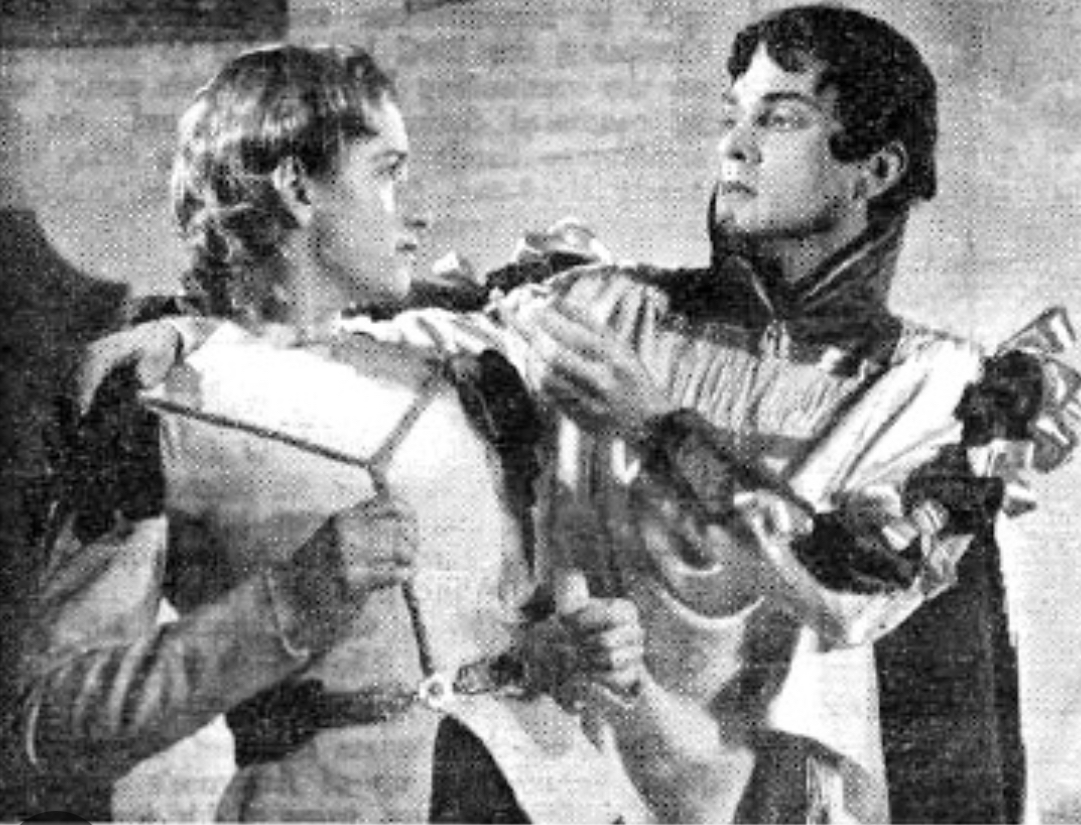
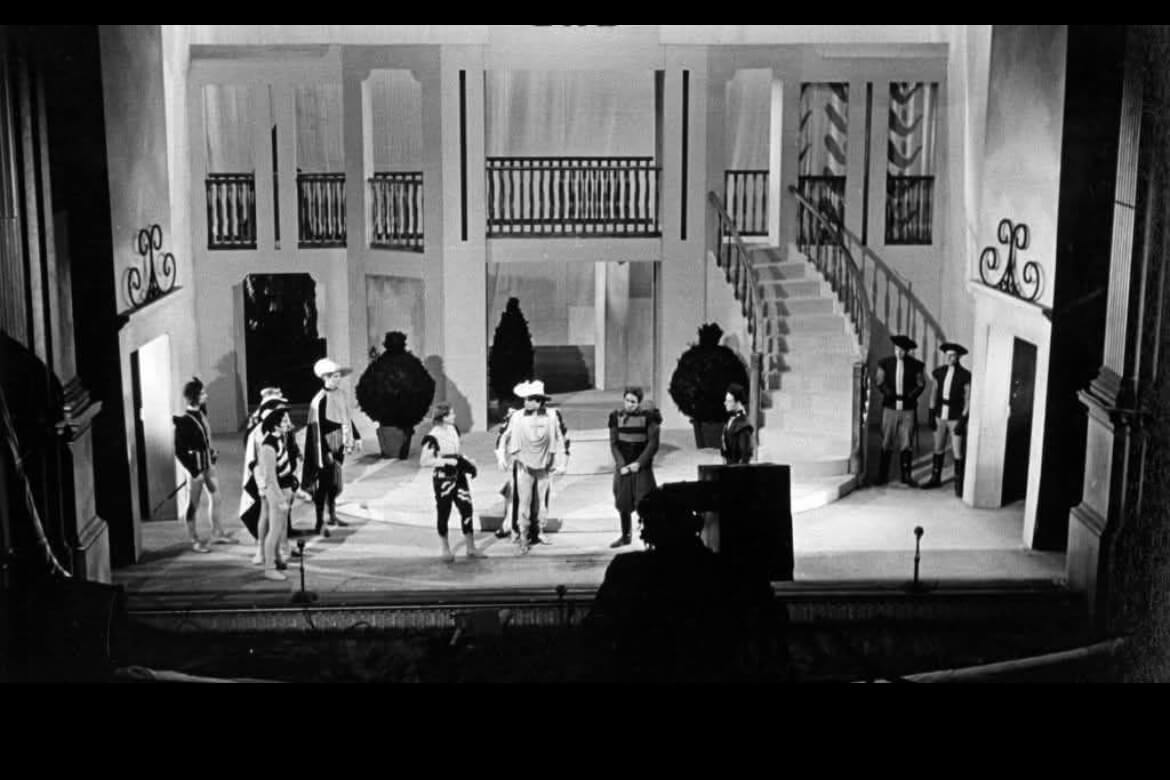
(Above left): Peggy Ashcroft as Viola and Esmond as Orsino on stage in Twelfth Night in late 1938.
(Above right): a production still taken during the BBC's live outside broadcast of the play from the Phoenix Theatre,
London, 2 January 1939. On stage, amongst others, are Peggy, Esmond and William Devlin who played Antonio.
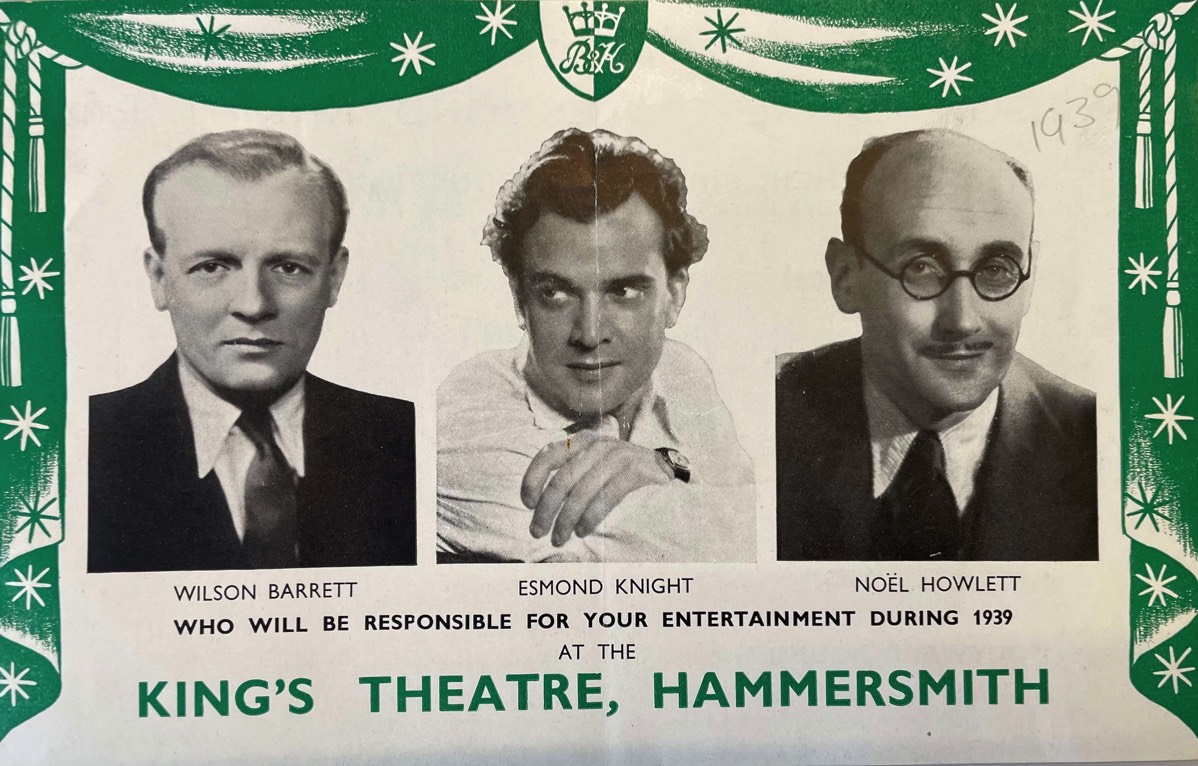
In the production of Van Gogh, which had run for four performances at the Arts Theatre Club, the part of Vincent's brother Theo had been played by Scottish actor Wilson Barrett. Hhe and Esmond had struck up a friendship. When Barrett was offered the finance to start his own repertory company, there was a condition attached - he must find a West End name to partner him. He remembered Esmond complaining in the dressing room about the quality of the parts he was being offered and the only way to do anything about it was to manage a theatre yourself. So in the autumn of 1938 Wilson approached Esmond at a hurried lunchtime meeting in a West End pub to discuss a possible business partnership. At the time, Esmond's run in Twelfth Night was grinding to a premature halt and the future seemed bleak, so this was a welcome proposition. He readily signed an agreement to manage jointly the King's Theatre in Hammersmith. Wilson Barrett & Esmond Knight Ltd. was created with fellow actor Noël Howlett as a third director.
Thus on 24th January 1939, Wilson Barrett & Esmond Knight Ltd. presented their first production - Noel Coward's three playlets collectively entitled Tonight at 8:30, with Esmond featuring in two out of the three; as Commander Peter Gilpin R.N. in Hands Across The Sea and as George Pepper in Red Peppers.
(Right) The King's Theatre, Hammersmith, where Wilson Barrett and Esmond struggled to run a repertory company in 1939 as the threat of war loomed large and theatre audiences were dwindling. Coincidentally the family who built the theatre in 1902 and owned it, the Mulhollands, were neighbours and friends of Esmond's parents in Putney.
(Picture courtesy of Matthew Lloyd)

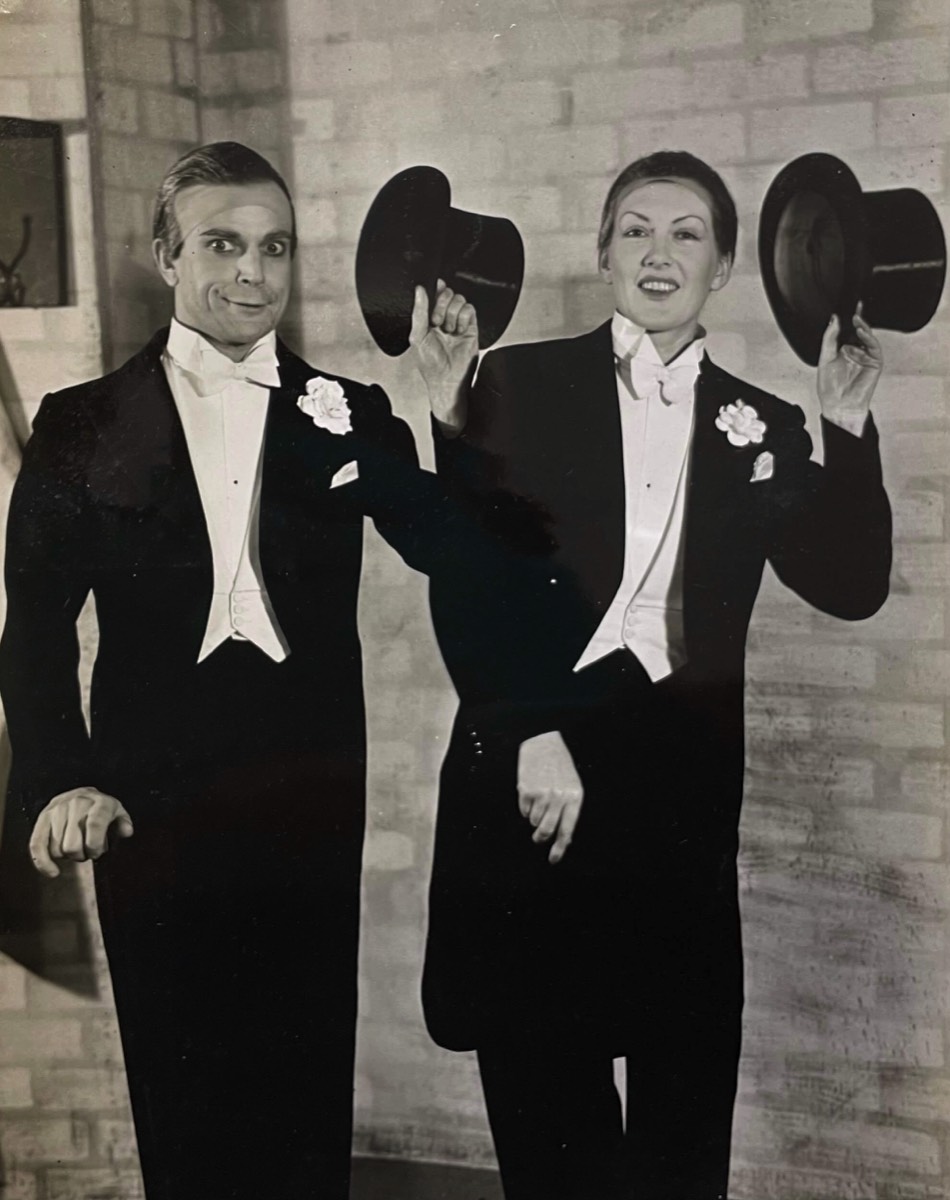
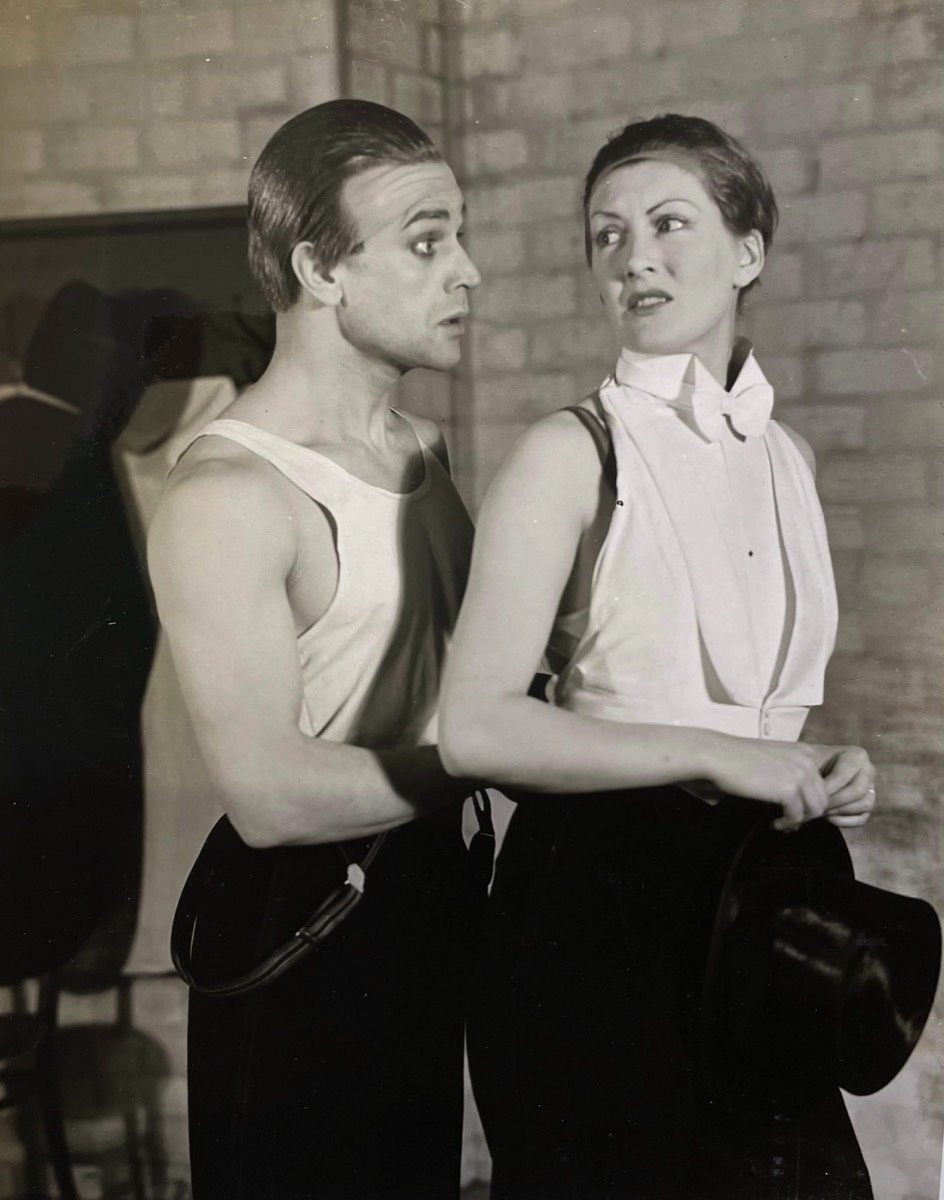
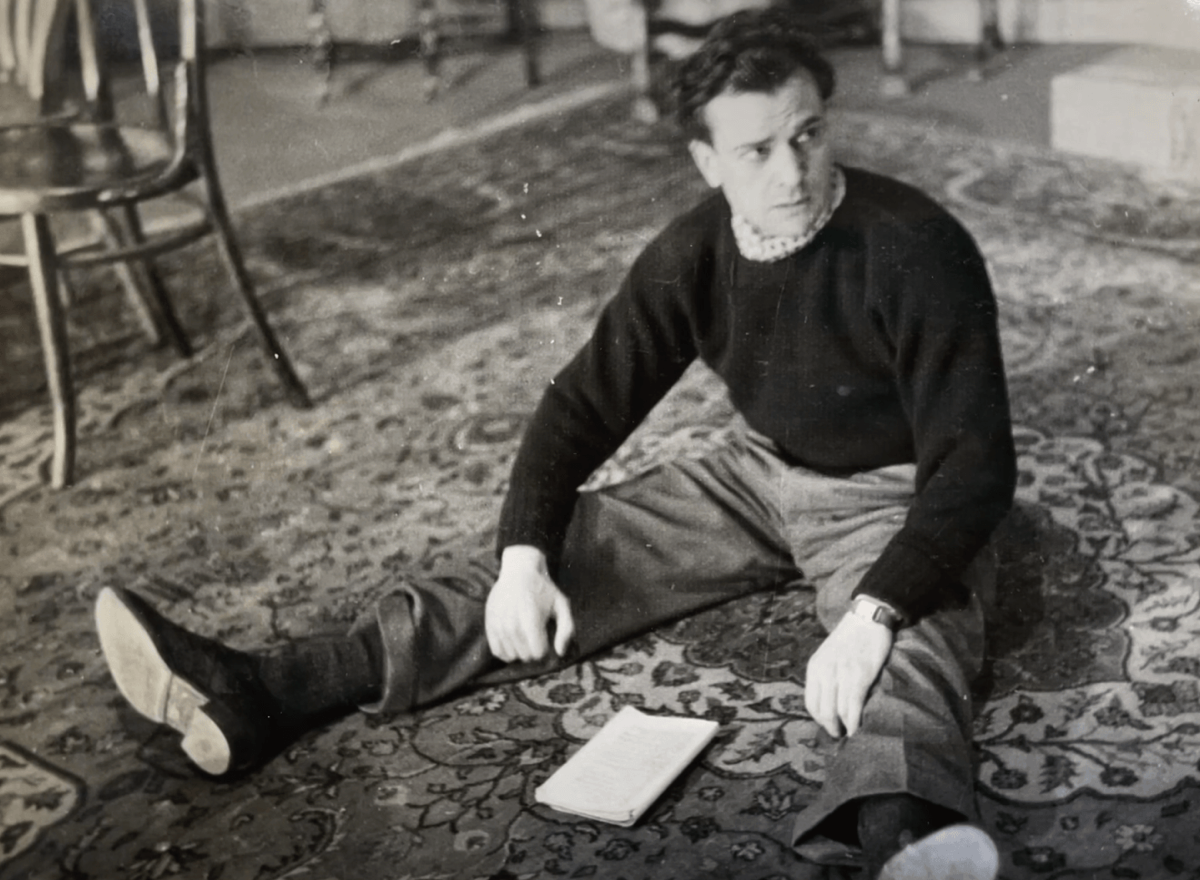
(Left) Esmond and Jane Carr as the Red Peppers in Tonight at 8:30, Wilson Barrett & Esmond Knight Ltd.'s first production at the King's Theatre, January 1939.
(Above) Esmond in another play from the same season - title unknown.
(Photos reproduced strictly under licence and with kind permission of the University of Bristol / Theatre Collection)
Tonight At 8:30 was followed by Night Must Fall in which Esmond repeated his role as the murderer Danny; Wilson Barrett played the Lord Chief Justice and Dame May Witty was also in the cast. Esmond also produced the play. Despite anxiety about the situation in Europe, the season started well and business was healthy. It was further enhanced by a visit from Queen Mary who came to see their production of George and Margaret. As one of the leading players, Esmond was introduced to her during the interval along with his co-star, Kitty de Legh, and the evening was a great success.
During their first season, the company put on twenty-four plays including Yellow Sands, Autumn Crocus (in which Esmond was joined by Nora Swinburne as a guest performer), Tonight at 8:30, You Can't Take It With You, Rain and a new play by Nicholas Phipps called First Stop North (with Judith Furse as a guest and special designs by her brother Roger). This play gave them the distinction of being the first ever repertory company to make a televised broadcast. The BBC took them to Alexander Palace one afternoon and broadcast First Stop North in its entirety.

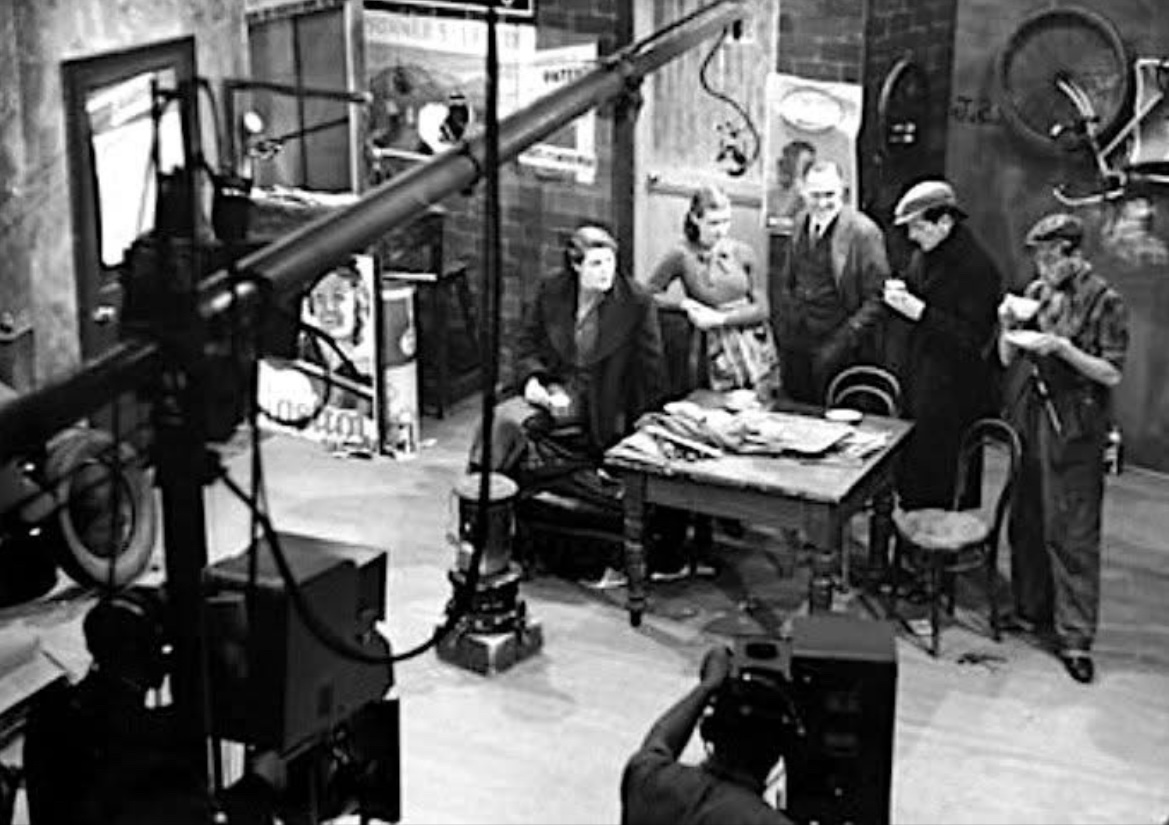
Esmond live on television. On Sunday 28th May 1939, the BBC took the whole production (cast and props) of First Stop North
from the King's Theatre to Alexandra Palace and broadcast the entire play without cuts. In the first picture (from left to right) are:
Judith Furse, George Larchet, Wilson Barrett, Alf Millen, Phoebe Kershaw and Esmond.
Artistically the season was a success, but financially things were less encouraging. Wilson Barrett later wrote:
" ... War was already looming, and business fluctuated wildly as Hitler went from coup to coup. In the middle of our eighth week he took Czechoslovakia and the bottom dropped out of everything for a week or two, but the company was magnificent and helped us to economise in every possible way, and by the time Nora Swinburne and Percy Heming came along to co-star with Esmond in Autumn Crocus, we were building up nicely again, only to be knocked down once more by the invasion of Albania. However, nearly every theatre in town was losing money, so we were in good company, and there was nothing to do but go on and hope for better times."

The situation was not helped by the I.R.A. who discouraged audiences locally by trying to blow up Hammersmith Bridge! Eventually it was decided to abandon the King's Theatre and transfer the company to the Empire Theatre in Edinburgh - at least for the summer season. Due to a film commitment Esmond was unable to travel with the rest of the company and had to follow on later. He was working on The Arsenal Stadium Mystery, a murder mystery based around a charity football match between Arsenal and a fictitious amateur team, The Trojans. The delay in production was partly due to the director of the film and the leading lady being involved in a car accident.
The Arsenal Stadium Mystery (1939) in which Esmond played alongside
professional footballers from the Arsenal and Brentford Town teams.
The film combined real footage of a match between Arsenal and Brentford Town (the last match Arsenal were to play before the outbreak of war) with sequences featuring Arsenal players mixed with actors. Esmond was not only working on a film set but also playing football with professionals. Being naturally athletic, he blended in well as Raille, the Trojan substitute who is called upon to play at the last minute and scores a vital goal. The film, and particularly the football sequences, seem dated when viewed today. Nevertheless it's well worth watching for a classic performance by Leslie Banks as the somewhat camp Inspector Slade who is more anxious to get back to his amateur dramatic production than finding the murderer!
In May 2006, Alf Fields, the only surviving member of the pre-war Arsenal team, recalled in a newspaper interview:
"I was also in the film, The Arsenal Stadium Mystery. It was a bit corny, but they took a few shots of us having a pre-match talk, all standing around talking. Then it was our job to pretend we were playing football. We had to re-enact Esmond Knight, the villain, trying to beat about three or four of us, which was a little bit difficult really. And I had only four words to say: 'Yes, he looked terrible,' but I had to practise them, mind!"
Filming had dragged on longer than anticipated. Apparently the main reason for the delay was caused by a motor accident involving the film's director, Thorold Dickinson, and his leading lady, Greta Gynt. Meanwhile the Barrett / Knight Company opened without Esmond in Edinburgh on 3rd July 1939 with a production of You Can't Take It With You. (Included in the cast was Grace Allardyce with whom Esmond had worked in his very first season at the Old Vic back in 1925; so too was Isobel Ohmead, Esmond's mother-in-law!) For the next few weeks Wilson Barrett had to cover for Esmond, playing two lots of roles as well as running the company. In The Edinburgh Evening News on 20th July, a switch-over of two plays was announced - Quality Street (in which Esmond took the lead) for Autumn Crocus (in which Barrett did) "… to ensure that Mr Knight will positively make his Edinburgh debut in Quality Street. Autumn Crocus will be staged next week and Quality Street the following week."
When Esmond's involvement in filming was finally over, he made his way north of the border just in time for the first night of not Quality Street but Love From A Stranger, a play written by an actor colleague, Frank Vosper (who had died a couple of years earlier at the age of just 37, at sea under mysterious circumstances). Understandably, Barrett was delighted and hugely relieved to see him. Unfortunately, however, audiences in Scotland were no better than they had been in London and the public were staying away, preoccupied as they were with what seemed the inevitability of war. In the last week of August they put on The Middle Watch, a comedy about the Royal Navy in which Esmond played the commander of a Royal Navy ship. But the small audience that came were not amused and Esmond and Wilson decide to abandon the season altogether at the end of the week. On Friday 1st September they heard that Germany had invaded Poland and after the final performance on the following evening, Esmond dashed from the theatre to Waverley Station to catch the night train to London.
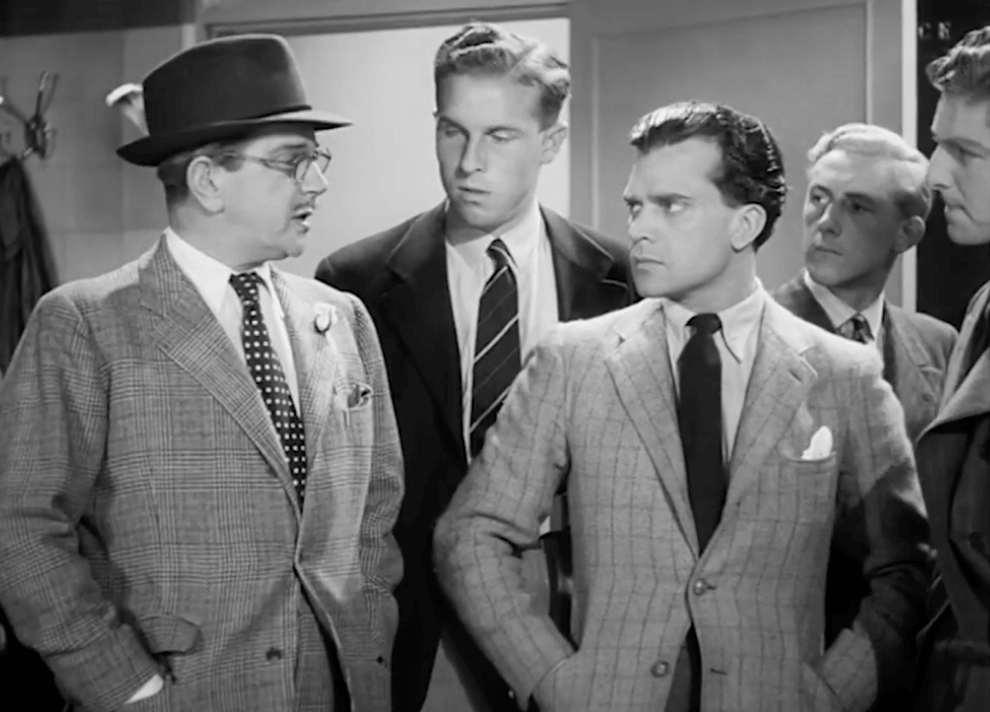
Esmond as Raille in The Arsenal Stadium Mystery (1939) in conversation with Leslie Banks as Inspector
Anthony Slade whose task it is to discover the murderer of one of the players who drops dead during a match.