The year 1951 ended with Esmond working for Michael Powell again, on stage rather than screen. Powell's venture into theatrical production was short lived and not hugely successful. Helois played at the Golders Green Hippodrome before transferring to the Duke of York's Theatre in London for a brief run. Actor / director Nigel Green was in the cast, too, and it was he who directed Esmond in April the following year in Montserrat, a play by Lillian Hellman. The leading role was played by Richard Burton at a time when he was just starting to break into major film roles having "trodden the boards" for eight years.
The cast spent a week performing at the Arts Theatre in Cambridge prior to full production at the Lyric Theatre, Hammersmith. A newspaper article at the time suggested that the production remained an "out of town" run (by which it meant Hammersmith as well as Cambridge) as this was necessary to answer the question: "Is it too grim for the glossy West End? … Miss Hellman's story, adapted from the French play of Emanuel Robies, tells us of one Captain Monserrat, a Spanish officer appalled by the pillage and terror caused by his own army in Venezuela. Monserrat turns traitor and subsequently assists revolutionary leader Simon Bolivar to bring his people liberty. The play is extremely harrowing and relentless in its horror. Its deaths and on-stage beatings make this an 'x-certificate' play. 'Streetcar' seems subdued by comparison. It boasts three outsized performances by Richard Burton, Noel Willman and Esmond Knight."
(Top right) - Richard Burton at about the time he worked with Esmond in the controversial play Monserrat. (Bottom right) - on stage together at the Lyric Theatre, Hammersmith - Noel Willman in the background.


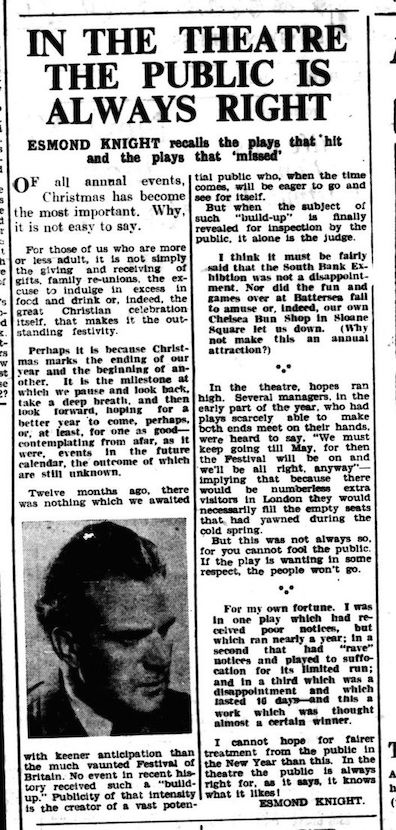
For a brief moment, Esmond changed professions and adopted the role of a journalist. He wrote an interesting article for his local newspaper, the Westminster & Pimlico News, which was published on 28th December 1951. It's a contemplative piece in which, amongst other things, he reviews the sense of anticipation that had preceded the year's ambitious and extremely popular Festival of Britain and considers whether the event itself merited the intense publicity and unprecedented "build-up". In his opinion it certainly did. As far as he was concerned, the evidence to substantiate this view was the extraordinary success it had been with the general public as a whole.
He then refers to the hopes and expectations of theatre managers, anticipating that the influx of visitors to London would fill what would otherwise be empty seats on the back of the festival almost as a certainty. Esmond, however, sees this as unadvised point of view. He states: "But this was not always so. If the play is wanting in some respect, the people won't go. For my own fortune, I was in one play which received poor notices, but which ran for nearly a year; in a second that had 'rave' notices and played to suffocation for its limited run; and in a third which was a disappointment and which last 16 days - and this a work which was thought almost a certain winner. I cannot hope for fairer treatment from the public in the New Year than this. In the theatre the public is always right for, as it says, it knows what it likes."
Pax Robertson Memorial Plaque
Back in April 1925, Esmond, aged eighteen and still at school, had made his stage debut at the Pax Robertson Salon in Bedford Hall, Hemus Place, Chelsea. On a Sunday afternoon in January 1952, he unveiled a plaque in memory of the actress and stage manager of the salon, Madge Pax Robertson, who had died several years earlier (1947). The Daily News London (7th January 1952) reported that in his speech at the ceremony Esmond stated it was largely due to the opportunity and encouragement he had been given by Miss Robertson that he had chosen to become an actor. He said: "I myself have most grateful and nostalgic memories of the 'Pax Robertson Salon', for it was there in that very atmospheric and candle-lit theatre that, while at Westminster School, I had my very first chance to show what I couldn't do 'on the boards'". Bedford Hall no longer existed, so the plaque was placed on its exact site (then the Chelsea Gaumont cinema) in Hemus Place. Esmond had in fact campaigned to have the street renamed Pax Robertson Place, but the council weren't playing ball and offered the plaque as a compromise. A further campaign to build a theatre named after her was unsuccessful. Esmond didn't have far to go for the unveiling ceremony - Hemus Place was (is) just five minutes' walk from his home in Bywater Street.
In 1952 he worked on two projects. The first, in July, was the live BBC broadcast of a play called Arrow to the Heart, repeated four days apart as was often the case in those days. The second was a film, Girdle of Gold, a light-hearted film in which once again Esmond played a Welshman, on this occasion a milkman called, appropriately, Evans the Milk. Then in the autumn there followed a theatrical season in a most unusual location - on the island of Bermuda in the North Atlantic Ocean. Esmond and Nora travelled there to perform at the Bermuda Festival which ran from 27th September to 1st December at the newly-built Bermudiana Theatre in Hamilton. Esmond was rather thankful that he was still around to make the trip. Shortly before departure, on 6th September, he had been at the Farnborough Air Show when a jet fighter disintegrated and fell into the crowd, killing thirty-one people (including the pilot, John Derry) and injuring many more. He was unharmed but it was a shocking experience.
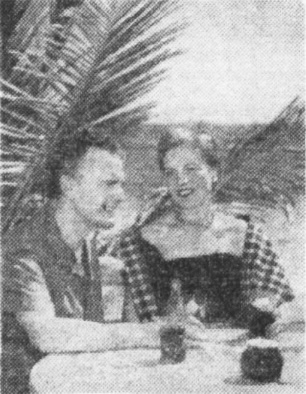
(Above) - a grainy photo of the Knights
at the Bermuda Festival, published in
The Strand magazine, October 1952.
As well as plays, the Bermuda Festival included concerts and an exhibition of Cecil Beaton's designs and photography. The stage productions were organised by the Bermuda Musical and Dramatic Society which divided the year into an American and an English season (the American company that year had included Burgess Meredith). Nora and Esmond featured in five plays - Travellers' Joy, Ring Around the Moon, Family Reunion, The Magistrate and Miranda - each with a run of a fortnight. Also in the small cast was Eric Berry, another Michael Powell regular who had appeared with Esmond in Contraband and The Red Shoes; also Bruce Yorke, Avice Landone and Brewster Mason.

(Above) - Frank N D Buchman, founder of the
Moral Re-Armament movement.
(Right) - the programme for the 1952 Bermuda Festival.

The trip to Bermuda was sponsored by 'Moral Re-Armamanet' (M.R.A.), an inter-denominational religious movement founded in 1938 by a Christian evangelist by the name of Frank N.D. Buchman. Nora had been interested in M.R.A. since the early 1940s when she found their philosophies helpful, notably in not giving up hope that Esmond might regain his sight during the period when he was totally blind. Their teachings developed from Buchman's earlier work with the Oxford Group, which he also founded back in 1921. M.R.A. beliefs were based on 'Four Absolutes' - honesty, purity, unselfishness, love - and the belief that personal change can lead to social change. Buchman himself put it thus: "Human nature can be changed. That is the root of the answer. National economies can be changed. That is the fruit of the answer. World history can be changed. That is the destiny of our age."
The idea of encouraging moral and spiritual reconstruction to build a "hate-free, fear-free, greed-free world" was popular in a post-war world. M.R.A. was very much associated with the man and interest began to fade after Buchman's death in 1961, although its influence is very much alive in contemporary movements such as Initiatives of Change (IofC). Nora's association with M.R.A. continued for many years, whereas Esmond's interest did not extend beyond working professionally for them once in a while - his religious beliefs wavered somewhere between atheism and agnosticism. (Something of an irony bearing in mind Lilian Bayliss had taken him on as a fledgling actor at the Old Vic back in 1925 straight out of school on the understanding that he was "a God-fearing boy"!)
Desert Island Discs
On 3rd October 1952 the BBC broadcast Desert Island Discs with Esmond being interviewed about his life by presenter Roy Plomley and playing his choice of recordings to take with him to his imagined place of solitude. These were:
…..1) Dance of the Blessed Spirits - Gluck
…..2) Shadrack - Louis Armstrong
…..3) Ding Dong Merrily on High / I Saw Three Ships - Kings College Chapel Choir
…..4) Brandenburg Concerto No.5 - J.S. Bach
…..5) Motor Car Racing, Jersey 28th April 1949 - Eric Findon
…..6) On the Plains, Fairy Trains - Thomas Weelkes (Cambridge University Madrigal Society)
…..7) London 1600 - William Walton (from the soundtrack of the film Henry V)
…..8) Allegro - G.F. Handel (which Allegro not known)
His book choice was The Story of Art by Sir Ernst Gombrich.
The year 1953 began with what seemed an exciting new venture for Esmond - his debut on the American stage, at the Ethel Barrymore Theatre on Broadway no less! He was offered a role in a new play by Hungarian writer and theatre director George Tabori called The Emperor's Clothes. The cast included Lee J Cobb in the main role (The Baron) and Maureen Stapleton, and told the story of a family living under political tyranny in 1930s Budapest. The play opened on 8th February, but did not fare well and the run lasted a mere sixteen performances, closing on 21st February. Negative reviews, including in The New York Times the day after opening night, had much to do with it, describing the play as unfocused and uneven, despite some strong acting. One critic felt that the play, much like the emperor in the original fairy tale, had "all too many clothes on, but not much underneath".

(Left) George Cole as David Bliss and Petula Clark as Penny Gay recording the radio sitcom A Life of Bliss. In early episodes Nora played Bliss's sister and Esmond his brother-in-law. Their parts were taken over by Diana Churchill and Colin Gordon.
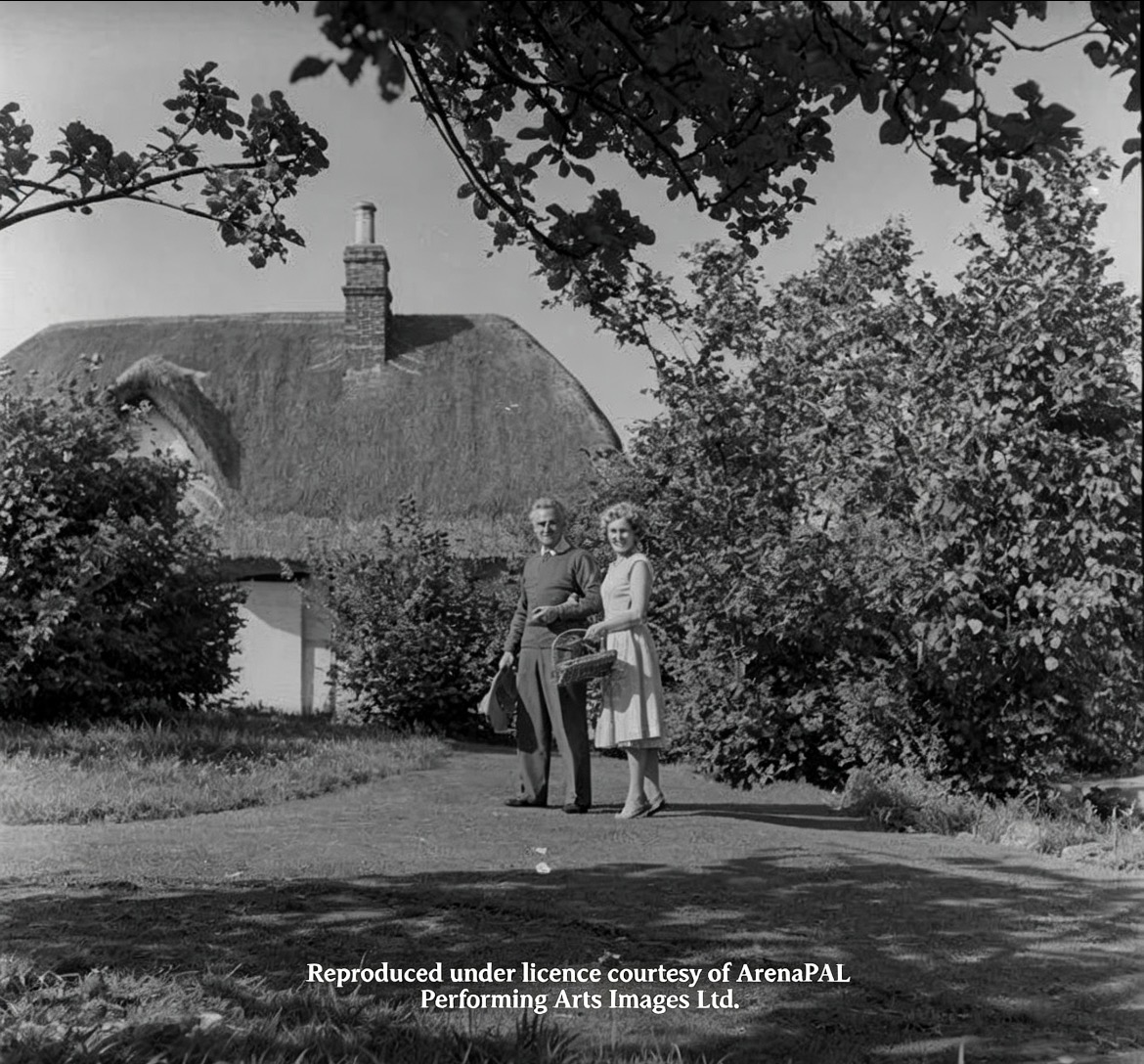
That same year, they acquired a charming thatched country cottage in the village of Weston Turville, near Aylesbury, Buckinghamshire, where they could escape and relax at weekends, and where Nora indulged in her passion for gardening and Esmond in his for painting (in the attic which had been converted into a studio). When they first bought it, the cottage - a Grade II listed building - was called Queensland Cottage, but Esmond had other ideas and it was soon rechristened Nora's Ark. They were within walking distance of the village pub, The Chandos Arms, and over the years became great friends with the landlord, Dick, and his wife Beryl. At one time Nora became worried that Esmond was spending far too long in the bar there!
(Right) In the garden at Nora's Ark, the cottage they purchased in 1953 and to where they retreated most weekends. Nora didn't drive and so this involved train journeys with luggage. Eventually it became too much, for Nora in particular, and reluctantly they sold it in 1967.
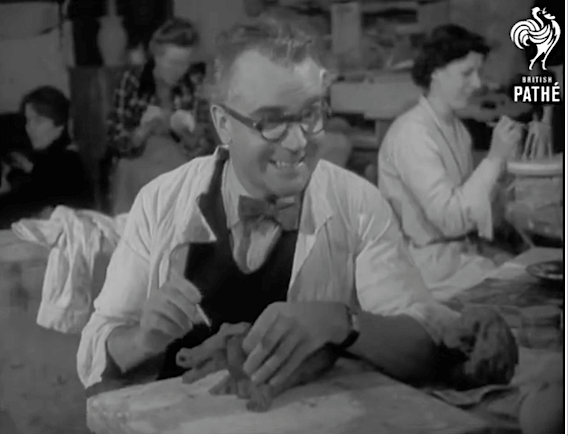
Also in 1954, British Pathé News filmed a newsreel piece about the Chelsea Pottery and Clay Club run by David Rawnsley, an art director who had worked on numerous high profile films including for Michael Powell & Emeric Pressburger (49th Parallel, One of Our Aircraft is Missing) and Noël Coward (In Which We Serve). He set up the club as a place for amateur artists to come in their spare time and work in clay and other mediums that would not otherwise be available to them. Naturally this appealed to Esmond and he was an enthusiastic member of the group. He can be seen in the newsreel (right) working on a sculpture of a dragon. Other Chelsea locals featured are a vicar and a court photographer. The newsreel is narrated by Eamonn Andrews who four years later would compère Esmond's appearance on his This is your Life programme.

In 1954, Rex Harrison directed and appeared in a production of Bell, Book and Candle at the Phoenix Theatre in London's West End, with Lilli Palmer, Athene Sayler and Wilfred Lawson in the cast. It ran for 485 performances, and roughly halfway (on 24th January 1955), Esmond took over from Lawson as Sidney Redlitch, an eccentric student of witchcraft, recently returned from Africa, for which he received critical praise for "spicing up the story". Towards the end of the run, Joan Greenwood took over from Lilli Palmer as the female lead.
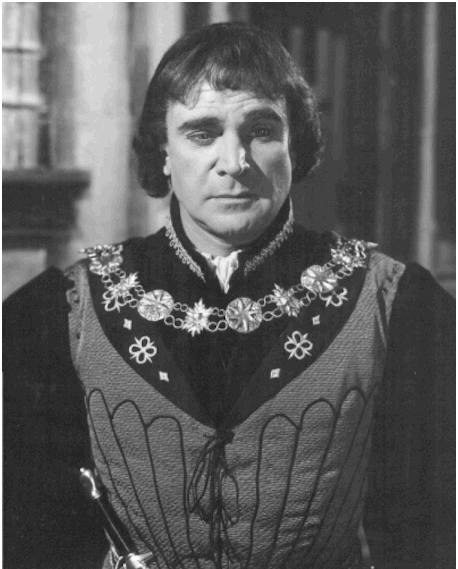
Esmond as Sir Richard Ratcliffe in Olivier's Richard III (1955)

Father and daughter at Shepperton Studios
during the filming of Richard III.
Rosalind played a lady-in-waiting.
Thus Esmond became one of only three actors to appear in all three of Olivier's Shakespeare films, the others being John Laurie and Russell Thorndike. As usual the cast was stunning and included Ralph Richardson, John Gielgud, Cedrick Hardwick, Claire Bloom and Stanley Baker. Shooting began in September 1954 in Spain, with a bull farm outside Madrid as the location for the Battle of Bosworth, and it wasn't until some weeks later that Esmond was required at Shepperton Studios to film his scenes. In some scenes he had the additional pleasure of working with Rosalind who, aged twenty-one, appeared (uncredited) as a lady-in-waiting.
Thus Esmond became one of only three actors to appear in all three of Olivier's Shakespeare films, the others being John Laurie and Russell Thorndike. As usual the cast was stunning and included Ralph Richardson, John Gielgud, Cedrick Hardwick, Claire Bloom and Stanley Baker. Shooting began in September 1954 in Spain, with a bull farm outside Madrid as the location for the Battle of Bosworth, and it wasn't until some weeks later that Esmond was required at Shepperton Studios to film his scenes. In some scenes he had the additional pleasure of working with Rosalind who, aged twenty-one, appeared (uncredited) as a lady-in-waiting.
Olivier's performance in Richard III is legendary and captured for posterity a role he had perfected on stage, with its innate sense of evil and ability to draw the audience into his sinister mind. The physical changes too were extraordinary, although the limp which Esmond and Rosalind observed on set was not entirely artificial; a misguided arrow during filming in Spain had embedded itself in Olivier's calf. Richard III was equally as successful as Henry V and Hamlet had been and once again brought a new and infinitely larger audience close to the work of William Shakespeare. When the film was first screened on television in the USA by NBC simultaneously in forty-five states, on 11th March 1956, it was watched by an estimated 62 million people - more than had seen the play in theatres in England since it was first performed in 1592.
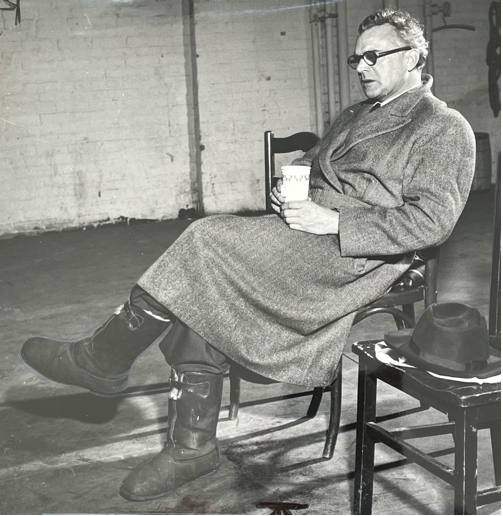
A press photograph of Esmond taken on 25th January 1953 during a break in rehearsals for The Emperor's New Clothes.
Sadly his Broadway debut did not fare well and the show only lasted sixteen performances. Perhaps his thoughtful pose
reflects concerns about the prospects of the production.