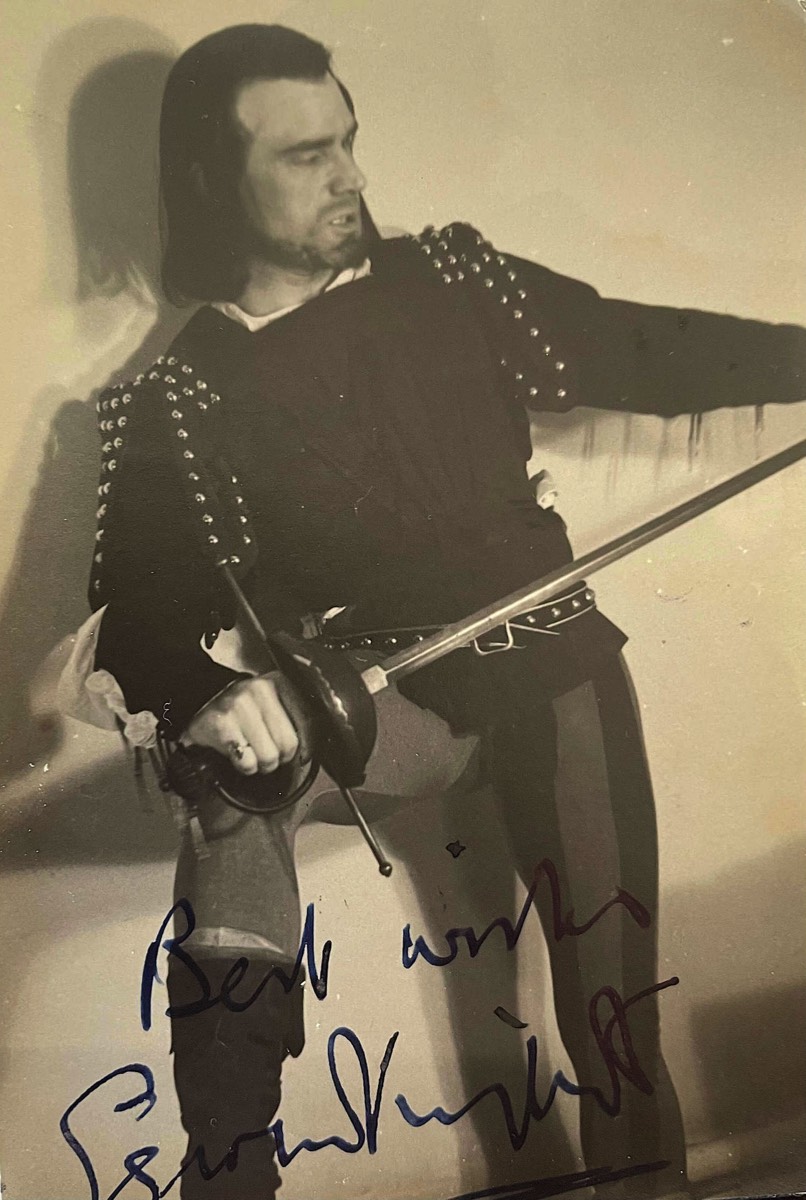
There now began one of the busiest and most fruitful periods of Esmond's career. In the next two years, spanning 1946-48), he worked on no less than seven films, including several of the finest ever produced in British studios. But this golden time began on stage, back at The King's Theatre, Hammersmith, where he and Wilson Barrett had struggled so hard to keep their heads above water seven years earlier as war loomed and theatre audiences dwindled. He joined a company that included Renee Asherson, Sybil Thorndike, Douglas Wilmer, Basil Langton, Lewis Casson and Michael Goodliffe. The season featured Saint Joan, Man and Superman, Elektra, In Time to Come and The Wiser Have Not Spoken. And there was Romeo and Juliet, in which Basil Langton played Romeo (and also directed), Renee Asherson was Juliet, and Esmond shone as Mercutio (kinsman and friend to Romeo). The part included a complex sword fight which he managed by meticulous, slow-motion rehearsal over a three week period, memorising exact step counts, and precise positions for his sword - and to great effect. The production opened on 1st March 1946 and was very well received. Clearly, Ernest Bevan in his review in the Daily Express was seriously impressed: "… a performance of extraordinary dash and fire by Esmond Knight as Mercutio. Shakespeare himself might have applauded this."
(Left) A signed publicity photo of Esmond as Mercutio in the
King's Theatre production of Romeo and Juliet (1946).
In the film world there were equally impressive projects; two were Powell and Pressburger masterpieces and another superb Laurence Olivier adaptation of Shakespeare, Hamlet. The first of these was Black Narcissus (1947), Powell and Pressburger's adaptation of the Rumer Godden novel about Anglo-Catholic nuns struggling to run a school and hospital for the local inhabitants, high up in the Himalayas, during the final years of British colonial rule in India. It depicts the growing tension between the sisters as they adapt to the harsh climate and often antagonistic population. And there's the disturbing presence of an English agent whose attractiveness brings physical temptation to the fore.

Esmond's appearance in Black Narcissus is brief but memorable and as characterful as ever as The Old General, the man who invites the nuns to live and work in this former "house of women". Thus his character is the catalyst that brings together the ingredients for what has frequently been regarded as one of the most erotic films ever produced in a British film studio. With the exception of a few jungle scenes filmed in a tropical garden in Sussex (Leonardslee Gardens) and a brief flashback sequence in Ireland, the entire convent and Himalayan backdrop was created at Pinewood Studios by Powell and his crew, notably cinematographer Jack Cardiff and production designer Alfred Junge (both won Oscars for their work) and cost designer Hein Heckroth who'd been in Esmond and Wilson Barrett's pre-war company at the King's Theatre, Hammersmith.

As The Old General - a publicity still from Powell and Pressburger's Black Narcissus (1947).
To Esmond's left is May Hallat as Angu Ayah and to the right David Farrar as Mr Dean.
So it was in Buckinghamshire rather than India that Esmond filmed his scenes, joined for some of the time by Rosalind when she was at home during the school holidays. They travelled up to Pinewood together, then Rosalind would take his arm and guide him on and off the set as and when he was needed. Some observers find the stop-start process of filming very tedious and dull, but Rosalind enjoyed it immensely and loved every minute. Nor was she intimidated by Michael Powell's often overpowering personality!

Behind the scenes at Pinewood Studios in Buckinghamshire during the filming of Black Narcissus. Esmond is on the left wearing some of the facial hair required for his role as The Old General, plus his
off screen, thick-lensed glasses. Centre is the director, Michael Powell, and on the right, actor Anton Walbrook who, although a regular in Powell & Pressburger productions (e.g. 49th Parallel, The Red Shoes,
The Life and Death of Colonel Blimp, Oh … Rosalinda!!) does not appear in this film, and so presumably
he was just visiting the set. The film was released in April 1947, just months before India achieved
independence. It's been suggested that the end of
the film, with the sisters abandoning their hospital and
school in the Himalayas, could be interpreted by viewers
at the time as a last farewell to the fading British empire - a respectful, rational retreat from somewhere that England never owned nor understood. Whether or not
this is accurate, the film remains loyal to Rumer Godden's 1939 book upon which it is based.
The same year, Esmond featured in two other films with Black Narcissus co-stars - Sabu in The End of The River (also produced by The Archers) directed by Derek Twist, and Jean Simmons in Uncle Silas. 1947 also brought Holiday Camp was the eminently forgettable The Likes of 'Er.
Holiday Camp is set in a post-war Butlins-style camp. Esmond plays the camp announcer whose voice is recognised by one of the holidaymakers (Flora Robson) as an old boyfriend. When they meet again it turns out that the announcer is now blind. (This is one of only a handful of parts in which Esmond actually played a blind person.) The film also introduced the world to the Huggett family who featured in several other films and a successful and long-running radio series in the 1950s. The film was directed by Ken Annakin who the following year would direct Nora Swinburne in one of her most memorable screen roles as The Colonel's Lady, one of the four Somerset Maugham short stories that comprised the film Quartet. The story was by writer and journalist Godfrey Winn who, incidentally, owned a copy of Esmond's autobiography Seeking the Bubble. [Author's note: now owned by me.]
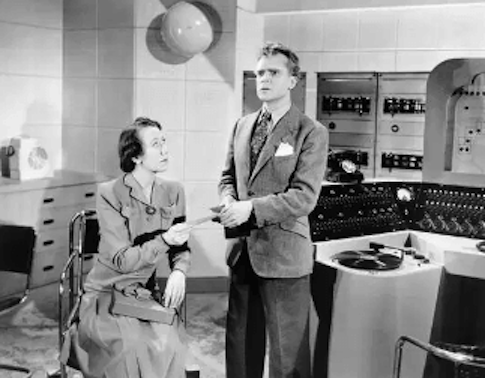
Holiday Camp (1947). Flora Robson meets the
camp announcer, an old boyfriend, who is now blind.
In October 1947, Esmond attended a committee meeting at Simpsons' Services Club to help arrange the premiere at the Leicester Square Theatre of a film called The Woman in the Hall, starring Ursula Jeans, Jean Simmons and Cecil Parker. The premiere was in aid of the Union Jack Club which was (and still is) a club and accommodation for serving and veteran members of all armed forces when in London. He made an inspiring appeal to those present, saying he "knew from experience what a godsend the Club was to men in the Forces". His contribution helped to raise £2,000 by the sale of tickets and donations. The film was well received and marked the debut (aged ten) of Susan Hampshire.
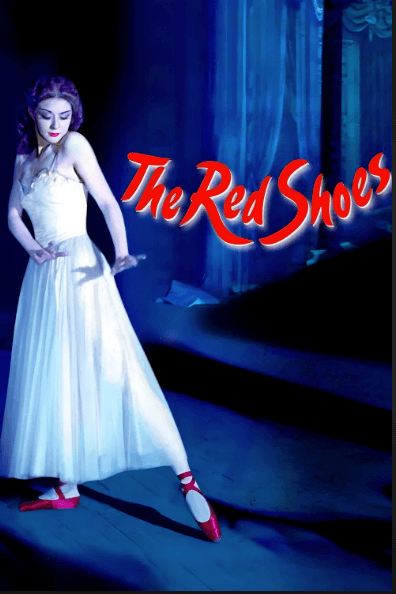
Then Michael Powell and Emeric Pressburger invited Esmond to play the part of Livingstone ("Livy") Montague in probably their best known film, The Red Shoes (1948). The story combines the Hans Christian Andersen fairy tale of that name with a love triangle based around a contemporary ballet company led by the charismatic Boris Lermantov (played by Anton Walbrook). Livy is the company's orchestral conductor and although incidental to the central storyline, Esmond's role is at certain moments very centre stage and includes conducting a full orchestra on several occasions. Rosalind was again at hand to guide him around the set at Pinewood, and this time Esmond was also required to go on location to the South of France. His co-stars included Robert Helpmann, with whom Esmond had worked before on stage in The Insect Play (Playhouse Theatre, 1938), and of course Moria Shearer whose husband-to-be, Ludovic Kennedy, had been in the Royal Navy and, on board HMS Tartar, involved in the eventual sinking of the Bismarck. In the 1970s, Kennedy would interview Esmond about his experiences on HMS Prince of Wales for his book, Pursuit - The Sinking of the Bismarck, and for a television documentary film, Battleship Bismarck.
Despite J. Arthur Rank's initial lack of enthusiasm towards the film Powell and Pressburger presented him with - he walked out of the premier and cancelled its showing in his cinema chain - The Red Shoes gradually developed a cult status and remains the definitive ballet film. It's also one of Esmond's most high-profile performances; thousands of people who may not know his name will be familiar with the aloof conductor, Livy, who at first treats the young composer / conductor, employed by Lermantov without his knowledge, in a very off-hand way but is won over by his music. According to Michael Powell in his autobiography (A Life in Movies): "Livy was a cross between Sir Thomas Beecham and Constant Lambert. Esmond endowed him with the polished rudeness of an upper-class Englishman and the keen perception of a perfectionist."
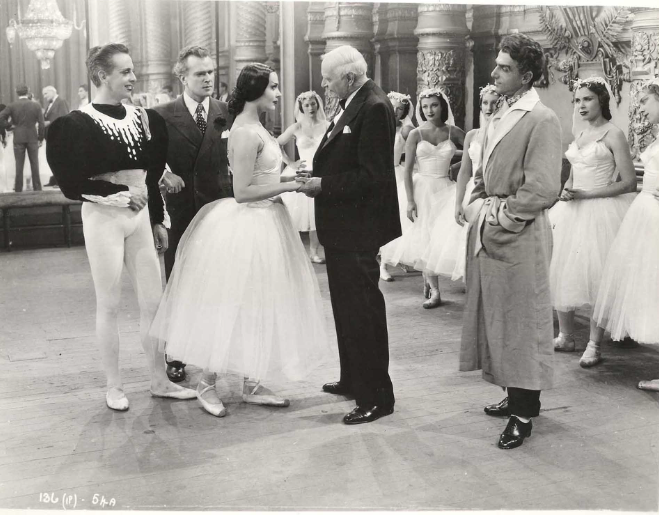

(Above) Stills taken on the set of The Red Shoes (1948), including Moira Shearer, Robert Helpmann,
Anton Walbrook, Esmond (leaning against the piano) and Leonide Massine.
(Pictures courtesy of the British Film Institute)
Whilst The Red Shoes was in production at Pinewood, Laurence Olivier was putting together the cast for his film version of Hamlet at Denham Studios, and recalled several actors who had appeared with him in Henry V four years earlier - Russell Thorndike, John Laurie, Niall MacGinnis, Felix Aylmer and - and Esmond Knight. He also called upon new talent in Jean Simmons to play Ophelia; Olivier had been impressed with her in David Lean's Great Expectations and recognised the extraordinary screen presence which had also won her the part of Kanchi in Black Narcissus.
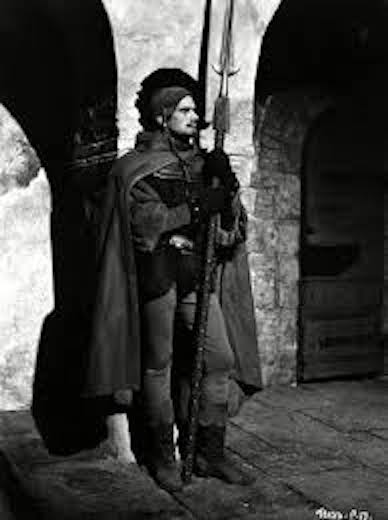
As Bernardo (pictured left), one of the captains of the guard who report sightings of the ghost of Hamlet's father, Esmond's appearance and dialogue open the film, and when the body count reaches its climax several hours later, he is there at the end, helping to shoulder Hamlet's lifeless body. Despite numerous criticisms, such as liberties taken with Shakespeare's text (at least 200 lines were cut from the play), the use of deep-focus photography and that at the age of forty Laurence Olivier was a little too old for the leading role, Hamlet was an enormous success, winning prizes at all the major film festivals. Notably, it was the first foreign film to win Hollywood's Oscar for Best Picture, and also the first British film to win four Oscars, the others being Best Actor for Olivier, Best Art Direction/Set Direction (Roger Furse and Carmen Dillon) and Best Costume Design (Roger Furse again). Jean Simmons was nominated for Best Actress but Claire Trevor won that year for her role in Key Largo. During filming, and with his hair still bleached blonde for the part, Olivier went to Buckingham Palace to receive a knighthood from King George VI.
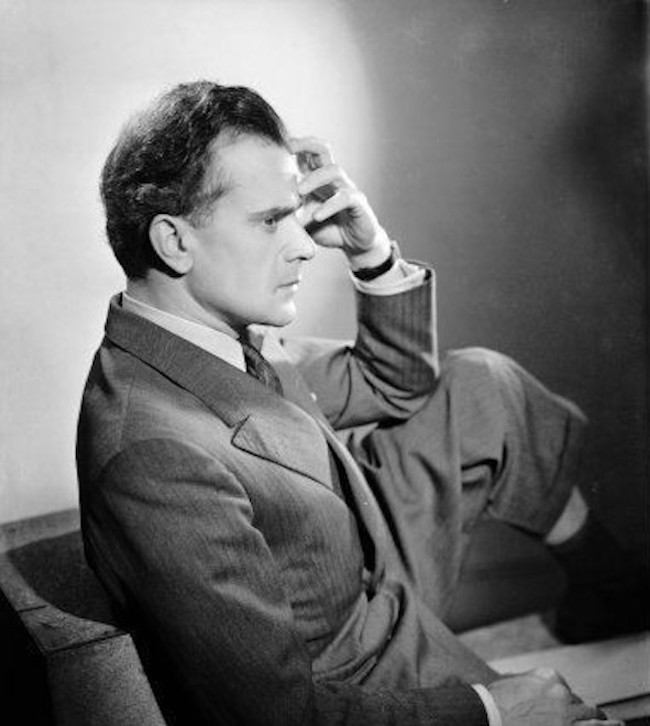
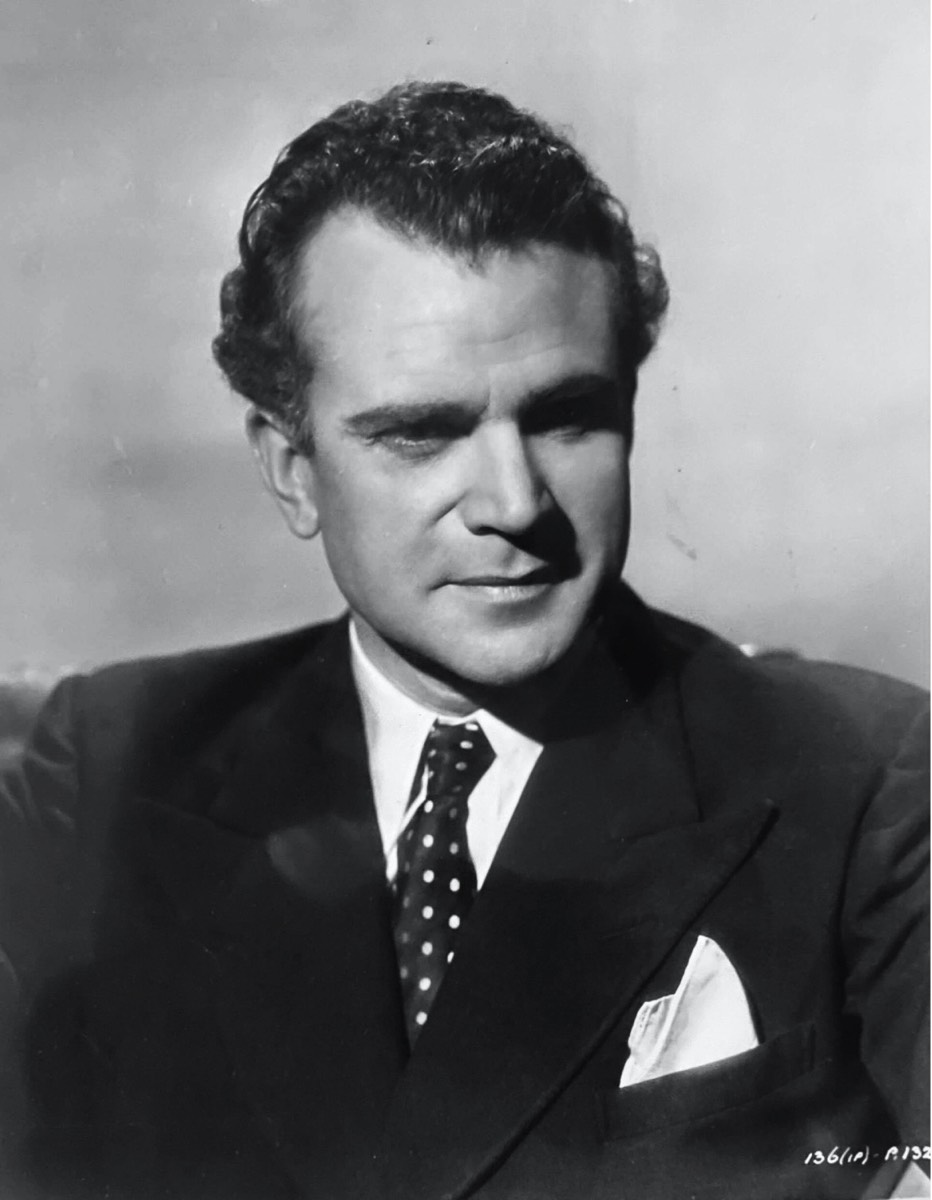
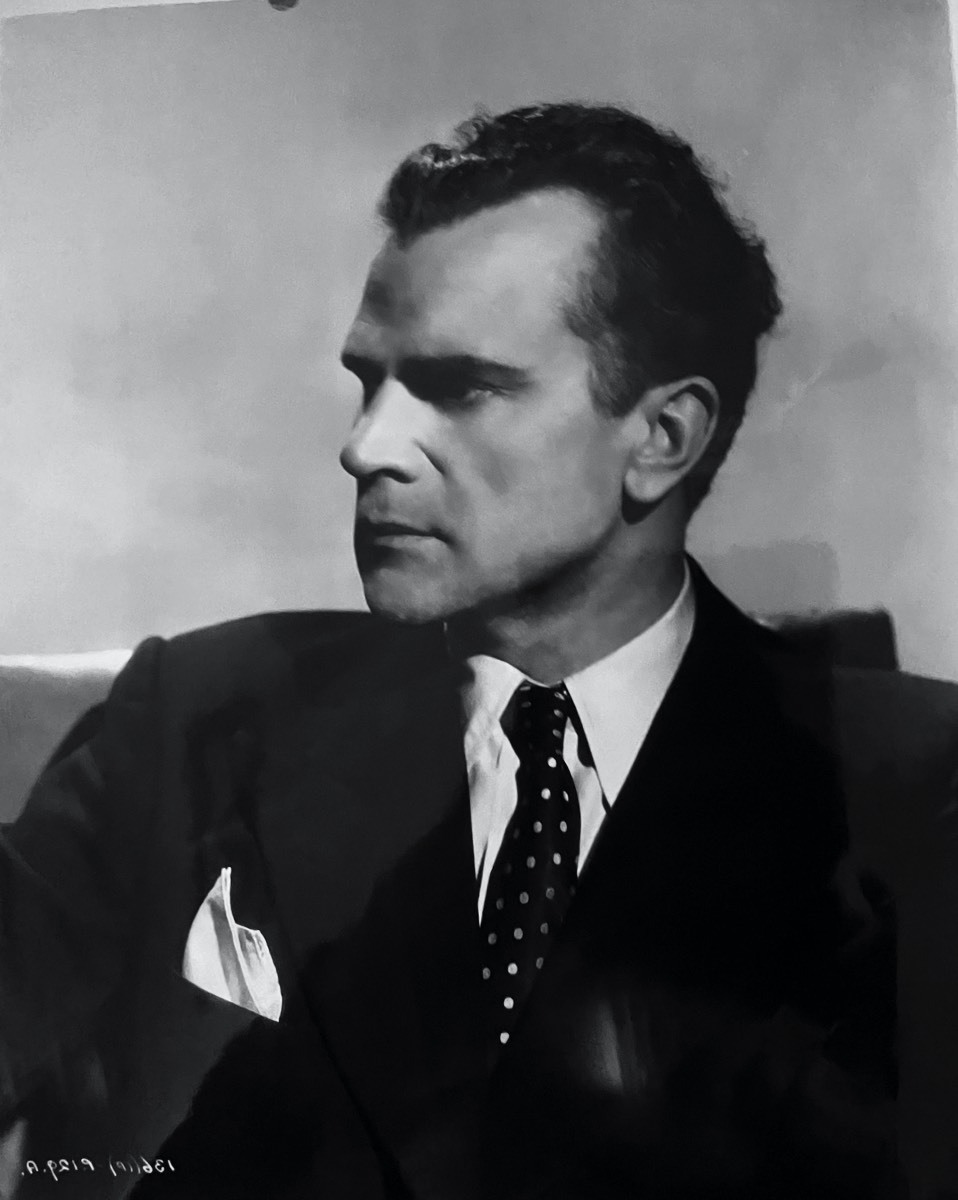
Three studio portraits of Esmond taken in 1948 when his career was thriving. On screen he could be seen in
The Red Shoes and Hamlet, and on stage in Stratford-upon-Avon with the Royal Shakespeare Company
as part of an extraordinary group of actors. It was also the year he took up painting.

A publicity still for Uncle Silas (1948) - in character as Dr Bryerly
(U.S. title - The Inheritance)
(Photograph courtesy of Rosalind Knight)